




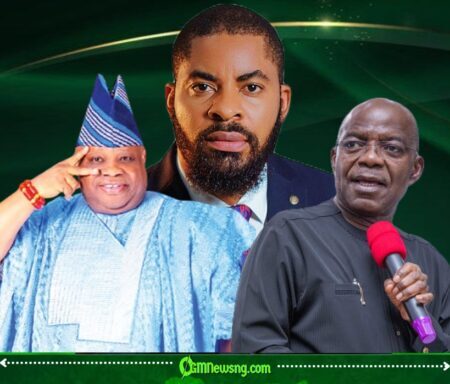
Barrister Deji Adeyanju has stirred widespread reactions after alleging that Governor Ademola Adeleke outperforms Governor Alex Otti in infrastructure development. The statement, which quickly gained traction on social media, has opened up fresh debate on governance performance and how it is measured in Nigeria’s political landscape.
Adeyanju’s remarks did not stop at infrastructure comparisons. He further alleged that one of the governors is engaged in paying influencers and skit makers to shape public perception. Although he did not provide detailed evidence within the statement, the claim has fueled speculation and drawn attention to the growing role of digital media in political communication.
The comments have resonated widely among citizens, political observers, and supporters of both administrations. While some have taken the claims at face value, others have called for caution, urging the public to seek verified facts before drawing conclusions. The situation highlights how a single political statement can quickly evolve into a national conversation.
Infrastructure Performance and Competing Narratives
Governor Ademola Adeleke has, in recent months, received commendation from supporters for ongoing road projects and urban renewal efforts within Osun State. Advocates of his administration argue that visible infrastructure development is a key indicator of governance effectiveness and long-term impact on citizens’ lives.
On the other hand, Governor Alex Otti has also been credited by his supporters with reforms in Abia State, including efforts aimed at improving public services, economic management, and urban infrastructure. His administration has emphasized transparency and fiscal discipline as central pillars of its governance strategy.
The contrasting narratives surrounding both leaders reveal a broader issue in Nigerian politics: the challenge of objectively measuring performance.
While some prioritize physical infrastructure such as roads and bridges, others focus on institutional reforms, financial management, and long-term planning. Adeyanju’s statement has, therefore, amplified an already ongoing debate about what truly defines effective leadership.
Influencer Politics and the Role of Digital Media
Adeyanju’s allegation regarding payments to influencers and skit makers has drawn attention to the increasing intersection between politics and social media. In recent years, Nigerian politicians and government agencies have embraced digital platforms to communicate achievements, counter criticism, and engage with younger audiences.
Supporters of this strategy argue that using influencers is simply a modern communication tool, similar to traditional media campaigns. They maintain that in an era dominated by social media, governments must adapt to remain visible and relevant to the public. From this perspective, influencer engagement is seen as a legitimate extension of public relations.
However, critics caution that such practices, if not transparent, could blur the line between genuine public engagement and paid propaganda. They argue that governance should be judged primarily by tangible results rather than online narratives. As the debate continues, Adeyanju’s remarks have once again placed the spotlight on accountability, transparency, and the evolving nature of political communication in Nigeria.
Table of Contents
Discover more from OGM News NG
Subscribe to get the latest posts sent to your email.