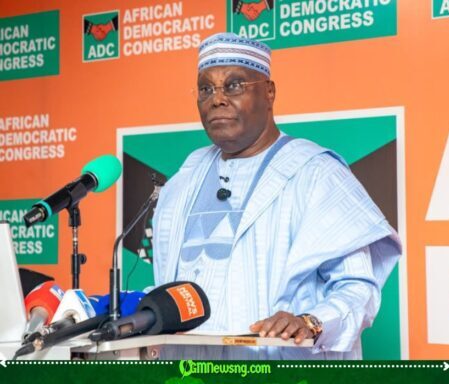









As the 2027 political season gathers momentum, African Democratic Congress (ADC) presidential candidate Atiku Abubakar has pushed back against a fresh political accusation over his position on the Nigeria Education Loan Fund (NELFUND), insisting that he is not against educating poor children but against making university students borrow their way into adulthood. The dispute erupted after President Bola Tinubu’s Special Assistant on Social Media, Dada Olusegun, accused Atiku of opposing NELFUND and allegedly believing that children from poor families should not have access to education. Atiku’s response, delivered through his Senior Special Assistant on Public Communication, Phrank Shaibu, was effectively: education, yes; lifelong debt as a graduation souvenir, no.
The argument is arriving at a politically convenient moment. With the 2027 presidential contest already heating up, education, cost of living and the economic pressure facing families are becoming increasingly important campaign issues. Recent political statements by Atiku have repeatedly focused on affordability and the burden facing ordinary Nigerians.
Atiku Draws the Line Between Education and Debt
According to Shaibu, Atiku’s objection is not to poor children entering universities but to a situation in which government allows educational costs to rise beyond what struggling families can afford and then presents a loan as the escape route. He illustrated the argument with the picture of a widow selling food by the roadside to keep her daughter in school, only for the daughter to graduate carrying a financial burden before she has even secured her first proper job.
The satire almost writes itself: in this version of the Nigerian dream, the child struggles through university, survives examinations, collects a degree and then receives a second qualification — Certified Debtor, Class of 2027. But behind the humour is a serious policy question. NELFUND officially describes its student-loan programme as a mechanism for breaking financial barriers to higher education, with loans covering institutional charges and, where applicable, upkeep. Its current terms also provide for repayment after NYSC, with repayment arrangements tied to income.
NELFUND Becomes Another Battlefield in the 2027 Campaign
Atiku’s position, as presented by Shaibu, is that education should become affordable enough that poor families do not have to choose between feeding their children and paying university bills. He called for scholarships, grants and lower education costs, arguing that children from disadvantaged backgrounds should be able to graduate without accumulating overwhelming debt.
That puts NELFUND at the centre of a wider political argument rather than simply an argument about whether student loans are good or bad. The federal student-loan framework was established specifically to provide eligible Nigerian students with zero-interest loans for higher-education charges and upkeep. At the same time, the official programme makes clear that the money is still a loan and comes with repayment obligations. In other words, the political disagreement is increasingly about whether loans should be the safety net or whether government should first make education affordable enough to reduce dependence on borrowing.
For Atiku, the answer appears straightforward: a poor child should not be denied university because the family lacks money, but neither should that child be told that the price of admission to the middle class is years of financial repayment. With Atiku campaigning as the ADC’s presidential candidate ahead of the 2027 election, education affordability is likely to remain part of the broader opposition argument against the Tinubu administration. Recent reporting shows the ADC already campaigning around economic issues, while divisions and competing ambitions continue to shape the wider opposition landscape.
The latest clash therefore leaves Nigerians with a question larger than the social-media exchange that triggered it: should the Nigerian child of a poor family graduate with a certificate, or graduate with a certificate and a repayment schedule attached? Atiku says his preference is clearly the former. As the 2027 political battle accelerates, OGM News NG will continue watching whether this argument develops into a serious education policy debate — or another political fight where everybody promises to rescue the poor child while the poor child’s school bill quietly waits.
Table of Contents
Discover more from OGM News NG
Subscribe to get the latest posts sent to your email.