









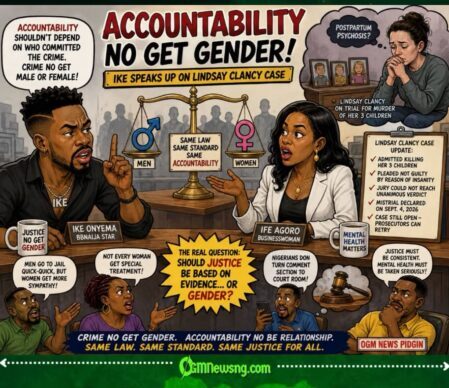
her serious gender argument after Big Brother Naija star Ike Onyema reportedly reacted to businesswoman Ife Agoro’s position on the Lindsay Clancy case, using the controversial
American murder trial to make a wider argument about how society treats men when questions of crime, mental health and responsibility come up.
The debate get plenty layers because the Lindsay Clancy matter itself never be ordinary courtroom story. Clancy admitted killing her three children but pleaded not guilty by reason of insanity, with her defence arguing that she was suffering from postpartum psychosis. On September 4, 2026, the jury failed to reach a unanimous verdict after almost 40 hours of deliberation, and the judge declared a mistrial. That means no conviction and no acquittal—the criminal case remains alive.
Men Vs Women Debate Reloaded As Ike Puts Accountability On The Table
According to the exclusive material supplied to OGM News Pidgin, Ike’s reaction centres on the argument that Accountability should not depend on whether the person accused of a serious offence na man or woman. His position, as presented in the material, is that society should be careful when sympathy, gender expectations or public sentiment begin to influence how people discuss criminal responsibility.
The argument don already provoke the kind of online conversation where everybody suddenly becomes lawyer, psychiatrist, judge and commentator—all inside one phone. But beneath the social-media gbas-gbos dey one legitimate question: if society believes in equal treatment, should the basic principle of Accountability remain the same regardless of the accused person’s gender? Ike’s intervention appears to be pushing that question directly into the public space.
Accountability No Be Women-Only Or Men-Only Matter, Ike Fires Fresh Argument
The actual Lindsay Clancy case, however, is more complicated than a simple “men versus women” argument. Prosecutors say Clancy deliberately killed her three children, while her defence says severe postpartum psychosis affected her ability to understand or control her actions. After weeks of testimony, jurors could not agree on whether she should be held criminally responsible, leading to the mistrial.
That distinction matters because Accountability in criminal law is not simply about deciding whether somebody did something terrible. Courts may also have to determine a defendant’s mental state, intent and legal responsibility. In this case, the defence relied heavily on postpartum psychosis, while prosecutors challenged the idea that the condition removed Clancy’s criminal responsibility. The September 4 mistrial means those arguments have not produced a final criminal verdict.
Postpartum psychosis itself is recognised by medical authorities as a rare but extremely serious psychiatric condition that can involve hallucinations, delusions, confusion and dramatic changes in mood or behaviour. The NHS describes it as a medical emergency, while the American College of Obstetricians and Gynecologists includes acute postpartum psychosis among the mental-health conditions that require proper screening and clinical attention.
This is where the conversation about Men also needs careful handling. Asking for equal accountability for men does not require dismissing genuine mental-health conditions affecting women, just as recognising mental illness should not automatically mean every accused person escapes legal responsibility. The two questions can exist together: society can demand fairness for men while still taking women’s mental-health crises seriously. Otherwise, the whole debate fit reduce to “my gender good, your gender bad,” and justice don turn football match.
The biggest takeaway from Ike’s intervention is therefore not simply whether people agree with him. The real issue is whether society can discuss crime without allowing gender sympathy to become a substitute for evidence, due process and consistent standards. The Lindsay Clancy trial has now ended in a mistrial, not a final judgment, so the legal story is far from finished. If prosecutors decide to retry the case, the arguments over mental illness, criminal responsibility and Accountability will likely return to the spotlight—and the debate over how society treats Men and women accused of serious crimes may become even louder.
Table of Contents
Discover more from OGM News NG
Subscribe to get the latest posts sent to your email.