









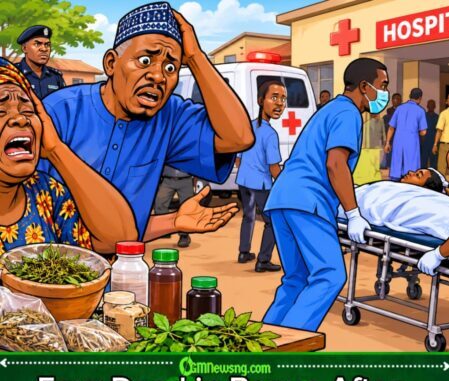
Four people don reportedly lose their lives for Oju, Benue State, after consuming suspected poisonous herbal mixture, while 14 other people don reportedly land for hospital as authorities investigate wetin fit become another serious warning about public health and unregulated medicinal preparations. Wetin suppose help people regain their health don allegedly become source of serious suffering, and the big question now be who actually checked the contents of the mixture before e enter the market?
The incident wey happen for Igede community don raise serious concern among residents, especially as different reports continue to give different figures about the number of people wey don die and those wey dey receive treatment. Three suspected sellers don reportedly enter police custody, but the matter no end with arrest alone. Nigerians need to know wetin dey inside the preparation, how e take cause the reported health complications and whether other people fit still dey exposed to the same substance.
THE MARKET-DAY MIXTURE AND THE TRAGEDY
According to reports, the incident reportedly followed the sale of herbal preparations by three men during Ihiejwo market day for Oju Township, headquarters of Oju Local Government Area. The three suspected sellers were identified in different reports as Alhaji Sule Mai Magani, Bello Mohamed and Musa Kala, although some reports use slightly different versions of the names.
An eyewitness identified as Ogbu reportedly said the trouble started becoming noticeable on Monday, November 2, 2026, after several residents who purchased and consumed the preparations began experiencing similar health complications. According to the account, the first victim reportedly died on Tuesday morning, another person died early Wednesday, while further deaths were reported as the incident developed. By November 6, Vanguard reported that the death toll had reached four, with 14 other people receiving medical attention and some reportedly in critical condition. Na serious matter wey no suppose get any market-day discount!
The Chairman of Oju Local Government Area, Jackson Ominyi, reportedly confirmed the incident but explained that he had not established the final number of casualties. He initially put the reported deaths at three, while assuring residents that affected persons were receiving attention at the General Hospital in Oju. The suspected sellers were also reportedly arrested following intervention by the Igede Youth Council and Oju Township Youth leadership, before being handed over to the police for investigation.
The President of the Igede Youth Council, Comrade John-Frank Ozzidi, reportedly appealed to the Benue State Government to ensure proper investigation and justice for the victims. He also commended community members for refusing to take the law into their own hands. This decision deserves recognition because when tragedy happens, allowing the police to investigate is far better than turning the community into another courtroom where anger becomes judge and executioner.
HERBAL MIXTURE, PUBLIC HEALTH AND THE REGULATORY QUESTIONS
The Benue incident has also reopened an important conversation about the safety of herbal preparations sold across Nigerian markets. Traditional medicine has existed in African communities for generations, and many people depend on herbal remedies for different health needs. However, the fact that a product comes from plants or carries the description of traditional medicine does not automatically make it safe. Some natural substances can be poisonous, while contamination, incorrect preparation, dangerous combinations and improper dosage can create serious health risks.
Nigeria’s National Agency for Food and Drug Administration and Control (NAFDAC) has regulations governing herbal medicines and related products, including registration, labelling and advertising requirements. These rules are important because consumers deserve to know what they are buying, the ingredients involved, the manufacturer or distributor responsible and the necessary safety information. The agency’s regulatory framework also prohibits misleading claims that suggest herbal products are universal cures or automatically safer than other medicines. Therefore, anybody selling medicinal preparations should understand that public health is not an opportunity for unchecked commercial experimentation.
The seriousness of this issue becomes clearer when considered alongside the reported September 2026 poisoning tragedy in Ondo State, where at least 48 people reportedly died and 182 others were affected after consuming a locally brewed herbal alcoholic drink contaminated with toxic industrial methanol. Although that incident involved a different product and reported contamination, it demonstrates the devastating consequences that unsafe substances can have when they enter community consumption. The Benue incident must therefore be investigated independently, without assuming that methanol or any other particular chemical caused the reported deaths. Laboratory examination of the suspected preparation and appropriate medical investigations will be essential to establishing the actual cause.
There is also a need for stronger public education, market surveillance and cooperation between local authorities, health workers, NAFDAC and law-enforcement agencies. The police have reportedly commenced investigation, although their initial casualty figures differed from those provided by eyewitnesses and other reports. While Vanguard reported four deaths and 14 people receiving treatment, subsequent police comments cited two deaths and four hospitalised persons, while the local government chairman initially confirmed three deaths. These differences make an authoritative update particularly important. The investigation must establish the final casualty figures, identify the actual contents of the preparation and determine whether the suspected sellers violated any applicable laws.
As the investigation continues, the most important priority should remain the survival and recovery of those receiving medical attention, alongside justice for families who have lost loved ones. Nigerians should avoid consuming unidentified herbal preparations or products making extraordinary medical claims without proper verification. Anybody experiencing unusual symptoms after taking a suspected preparation should seek immediate medical attention rather than waiting for the condition to become worse.
The Benue tragedy is another painful reminder that traditional healing must go hand in hand with safety, accountability and proper regulation. Arresting suspected sellers may be an important first step, but the real solution requires finding out exactly what happened and preventing a repeat. For now, Oju deserves answers, the victims deserve justice, and Nigerians deserve to know that the next medicine they buy will not become another reason to visit the hospital. OGM News Pidgin will continue to monitor developments and bring readers verified updates as more facts emerge.
Table of Contents
Discover more from OGM News NG
Subscribe to get the latest posts sent to your email.