




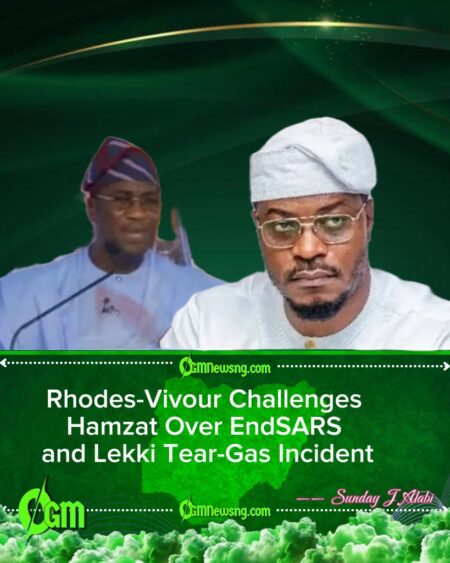
The lingering controversy surrounding the October 2020 #EndSARS protests returned to the centre of Lagos politics on Sunday as African Democratic Congress (ADC) governorship candidate, Gbadebo Rhodes-Vivour, challenged Deputy Governor Obafemi Hamzat over his account of the state government’s handling of the protests and their aftermath.
Speaking during the 2026 Lagos governorship debate organised by the Nigeria Debate Consortium, Rhodes-Vivour questioned the sincerity and consistency of Hamzat’s expressed sympathy for victims of the historic protests, recalling that he and Nigeria Democratic Congress (NDC) governorship candidate Funso Doherty were among those allegedly tear-gassed by police during a memorial gathering at the Lekki tollgate on October 20, 2026.
Apparently, the opposition candidate wanted Lagosians to understand that expressing sympathy for victims of police brutality is one thing, while ensuring that citizens can peacefully remember those victims without encountering tear gas is another. After all, what better way to demonstrate respect for a painful history than to allow people to remember it without creating another uncomfortable chapter?
Hamzat Defends Government’s Response as Rhodes-Vivour Questions Its Consistency
Hamzat, who represented the All Progressives Congress (APC) at the debate, described October 20, 2020, as a deeply painful day for Lagos residents. He acknowledged his presence during the period and insisted that he would never dismiss or disregard the suffering experienced by citizens.
In defending the state government’s response, the deputy governor highlighted the establishment of the Lagos State Judicial Panel of Inquiry, which investigated allegations of police brutality and the Lekki tollgate incident. He also pointed to the panel’s report and the subsequent government White Paper as evidence that steps had been taken to address the grievances. Hamzat further argued that the military operates under the Federal Government, not the Lagos State Government.
However, Rhodes-Vivour was apparently unconvinced that the existence of a judicial panel and a government White Paper should automatically settle questions about accountability. His intervention effectively reminded the audience that establishing a committee, receiving a report and implementing recommendations are different stages of governance. In political terms, having a file marked resolved does not necessarily mean that the people affected have stopped asking questions.
The opposition candidate then introduced the October 2026 Lekki memorial incident as a practical test of the government’s commitment to protecting citizens’ rights. According to his account, he and Funso Doherty were attempting to lay flowers in remembrance of #EndSARS victims when police officers deployed tear gas to disperse the gathering.
Lekki Memorial Incident Reopens the Debate Over Police Brutality and Opposition Rights
The October 20, 2026, incident occurred during a memorial organised by the Enough is Enough movement to commemorate the sixth anniversary of the #EndSARS protests. The gathering was intended to honour victims of the demonstrations, but police officers reportedly dispersed participants with tear gas before the planned wreath-laying ceremony could be completed.
Rhodes-Vivour argued that the incident exposed what he described as the normalisation of violence against opposition parties in Lagos. His central argument was that the government’s sympathetic language about the suffering of 2020 appeared inconsistent with the treatment of opposition politicians attempting to participate in a peaceful remembrance ceremony in 2026.
For context, the Lagos State Judicial Panel of Inquiry submitted its reports in November 2021 after investigating police brutality and the Lekki incident. The state government’s White Paper accepted 11 of the panel’s 32 recommendations, accepted six with modifications, rejected one and referred 14 to the Federal Government as matters outside its jurisdiction. The panel’s findings and the government’s response remained controversial, particularly over the circumstances and fatalities surrounding the Lekki incident.
The latest confrontation therefore raises an uncomfortable question for the Lagos political establishment: if the state has learned important lessons from the #EndSARS tragedy, why did a memorial intended to honour its victims reportedly end with another encounter involving tear gas? For the opposition, this is a question of democratic freedom and accountability. For the government, it is an opportunity to explain the circumstances surrounding the police response and demonstrate that lessons from the past have translated into better practices.
The exchange between Rhodes-Vivour and Hamzat has ensured that #EndSARS remains more than a historical reference in the unfolding battle for Lagos ahead of the 2027 governorship election. While Hamzat points to the judicial panel and the government’s official response, Rhodes-Vivour insists that the treatment of opposition figures at the 2026 memorial tells a different story. Lagosians deserve clear answers about the police action, the protection of peaceful gatherings and the implementation of lessons from 2020. One thing is certain: the political argument over Lekki is far from over, and OGM News NG will continue to follow developments as the 2027 election conversation gathers momentum
Table of Contents
Discover more from OGM News NG
Subscribe to get the latest posts sent to your email.