




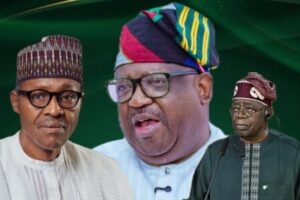






Nigeria’s preparations for the 2027 general elections have come under fresh scrutiny after former Kogi West Senator Dino Melaye accused the Independent National Electoral Commission (INEC) of allegedly helping the ruling All Progressives Congress (APC) manipulate the electoral process. Melaye, who made the allegation during an interview on Arise Television’s Prime Time programme on Monday, described the electoral commission’s performance as a failure and questioned whether Nigerians could trust an institution struggling to maintain the integrity of its own voter register.
According to Melaye, the alleged repetition of photographs, suspicious voter registration entries and discrepancies in polling-unit figures raise serious questions about INEC’s commitment to electoral transparency. He also accused the commission of violating provisions of the Electoral Act, warning that an institution responsible for enforcing electoral laws must not become an alleged violator of those same laws. In a country where politicians frequently accuse one another of electoral manipulation, the latest controversy has added another uncomfortable chapter to the preparations for 2027.
INEC’S VOTER REGISTER UNDER FIRE AS MELAYE QUESTIONS ELECTORAL INTEGRITY
Melaye alleged that INEC’s voter registration database contained repeated photographs and suspicious records, claiming that an integrity assessment revealed an 89 per cent AI-related imputation problem. He argued that such irregularities should not be dismissed as ordinary administrative mistakes, particularly when the credibility of the national voters’ register is central to determining the legitimacy of future elections. His allegation comes amid growing public concerns about the appearance of questionable photographs and other inconsistencies in the preliminary register released by INEC.
Interestingly, INEC has acknowledged that its preliminary voter register contains questionable records, including suspected AI-generated photographs. The commission’s Director of Information and Communication Technology, Lawrence Bayode, disclosed that some registration officers allegedly exploited their official access credentials to introduce irregularities into the database. INEC subsequently identified 268 records for review and announced that corrective measures were underway. However, the commission has maintained that the preliminary register is not the final certified document.
ELECTORAL ACT CONTROVERSY AND THE 4,000-VOTER QUESTION
Another major issue raised by Melaye concerns the statutory requirement for public scrutiny of the voters’ register. He alleged that INEC failed to comply with the prescribed timeline for publishing the register, arguing that the commission had allowed the deadline to pass without fulfilling its obligations. The controversy is significant because Section 19(1) of the Electoral Act 2026 requires INEC to make the voters’ register available for public scrutiny both online and at designated registration areas for seven days within the stipulated period before a general election. Reports confirmed that INEC missed the relevant publication deadline before eventually making the preliminary register available online on October 26.
Melaye also questioned an alleged increase in the number of registered voters at the polling unit associated with the Edo State governor. According to him, the polling unit reportedly had more than 400 registered voters during the election that produced the governor approximately two years ago, but the new register allegedly shows more than 4,000 voters. He described the reported increase as exceeding 1,000 per cent and demanded explanations. If independently established, such a discrepancy would deserve serious investigation. After all, a polling unit’s voter population should not suddenly experience a population explosion without a credible explanation. However, the specific figures and their comparison require independent verification before they can be treated as established facts.
The controversy presents INEC with a difficult public-relations challenge: convincing Nigerians that its electoral machinery is reliable while simultaneously investigating irregularities within its own database. The commission has indicated that it is cleaning up the preliminary register and expects to complete the process before certifying the final register on December 15, 2026. INEC
Dino Melaye’s allegations have once again placed INEC’s credibility under the spotlight ahead of the 2027 general elections. Although his accusation that the commission is helping APC rig the election remains an allegation rather than an established finding, the acknowledged irregularities in the preliminary voters’ register make the demand for transparency particularly important. Nigerians deserve an electoral process in which every registered voter is genuine, every polling-unit figure is explainable and every political party competes under the same rules. INEC must provide convincing answers, investigate suspicious records and demonstrate that its commitment to credible elections goes beyond public assurances. The 2027 election should be decided by voters, not by questionable entries in a database. Stay with OGM News NG for further developments.
Table of Contents
Discover more from OGM News NG
Subscribe to get the latest posts sent to your email.