

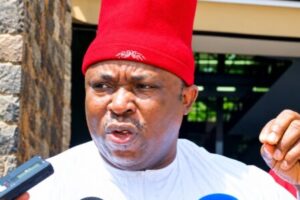





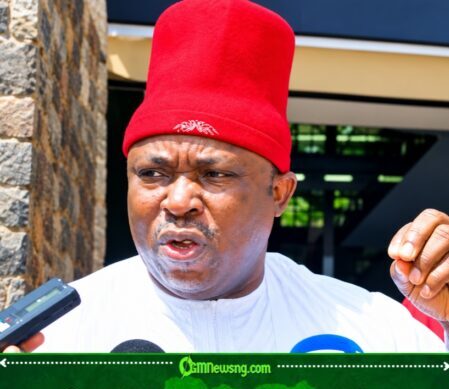
Senator Victor Umeh has questioned the Federal Government’s borrowing practices, asking why Nigeria continues to accumulate substantial debt while many citizens struggle with rising living costs and economic uncertainty.
Umeh argued that the effectiveness of government borrowing should be measured by its impact on the lives of Nigerians rather than by economic statistics alone. His remarks have renewed debate about public spending, fiscal responsibility and whether borrowed funds are delivering the expected benefits to the country.
Victor Umeh Questions the Benefits of Nigeria’s Rising Debt
Speaking about the nation’s economic situation, Umeh expressed concern over what he described as excessive borrowing, questioning how the funds obtained by the government have been utilised.
The senator stressed that borrowing should produce measurable improvements in critical areas such as infrastructure, energy supply, employment and citizens’ purchasing power. He maintained that when substantial financial resources are committed to economic policies without a corresponding reduction in hardship, the government must explain the results.
Victor Umeh also challenged the argument that debt should be assessed mainly in relation to the size of the economy. In his view, the practical effects of government spending on households and businesses deserve greater attention.
Senator Raises Questions About Refinery Capacity and Fuel Prices
Victor Umeh questioned why Nigeria continues to face challenges with petroleum product prices despite the substantial sums borrowed over the years. He specifically referred to billions of dollars in borrowing and asked whether comparable resources could have been used to strengthen domestic refining capacity.
His comments reflect broader concerns about Nigeria’s energy sector, including the relationship between domestic refining, fuel supply, foreign exchange pressures and the cost of petroleum products. However, the amount required to build or expand a refinery depends on its capacity, location, technology and supporting infrastructure.
The senator’s argument is that public borrowing should be connected to projects capable of producing lasting economic benefits. For citizens facing high transport costs and expensive goods and services, the central concern is whether government policies are improving daily life.
Government Accountability Becomes Central to the Debate
Victor Umeh’s remarks have brought renewed attention to the need for transparency in public borrowing and expenditure. Borrowing can finance infrastructure and other development projects, but its long-term value depends on how funds are allocated, managed and converted into productive assets.
The government’s economic decisions can therefore be assessed through practical indicators, including infrastructure delivery, job creation, electricity supply, healthcare, education and the purchasing power of households. Clear reporting on borrowed funds and project outcomes would help Nigerians understand what the country has gained from its debt obligations.
At the same time, evaluating Nigeria’s debt position requires distinguishing between total public debt, the cost of servicing that debt and the specific uses of borrowed funds. The figure of ₦166 trillion cited by Umeh should be considered in the context of the relevant reporting period and the debt measure being discussed. Senator Victor Umeh’s question about the destination of Nigeria’s borrowed funds has renewed an important debate about fiscal responsibility and the practical benefits of government spending. While borrowing can support development when properly managed, citizens have legitimate reasons to demand transparency and measurable results.
The challenge for the Federal Government is to demonstrate how its borrowing and economic policies are contributing to sustainable development and easing the pressures faced by households and businesses. OGM News NG will continue to follow developments concerning Nigeria’s public debt, government expenditure and the impact of economic policies on citizens.
Table of Contents
Discover more from OGM News NG
Subscribe to get the latest posts sent to your email.