







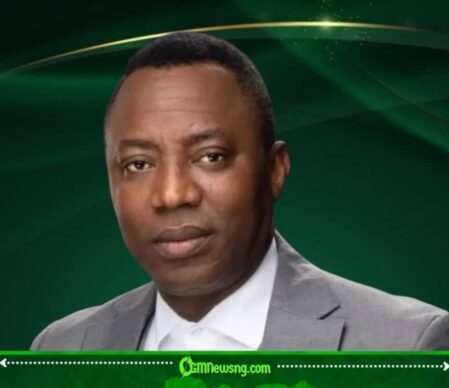
Omoyele Sowore has once again entered Nigeria’s ever-expanding courtroom debate over what citizens can say about political leaders, reportedly maintaining that calling President Bola Ahmed Tinubu names is not, by itself, an offence. The statement lands with particular comic timing because Sowore is already facing a Federal High Court case arising from social-media posts in which he described Tinubu as a “criminal.” The case has therefore transformed what might ordinarily be a heated political argument into a legal examination of words, meanings, intentions and, apparently, how much trouble one adjective can cause.
When an Insult Becomes a Courtroom Matter
The controversy goes back to August 2025, when Sowore published posts on X and Facebook accusing Tinubu of being a criminal and criticising comments attributed to the President concerning corruption in Nigeria. The DSS subsequently took the matter to the Federal High Court, seeking judicial determination over whether describing the President or another person as a “criminal” could amount to cyberbullying or other offences under Nigerian law.
Sowore’s defence has now turned the courtroom into something resembling a national seminar on freedom of expression. In July, his first defence witness, lawyer Deji Adeyanju, testified that Tinubu had previously said Nigerians had the right to criticise, insult and call him names as part of democratic freedoms. The prosecution, however, has maintained its case, while the court has proceeded to examine the specific allegations before it rather than simply deciding the matter on the basis of political arguments.
The Nigerian Name-Calling Constitution Nobody Has Seen
And this is where the story becomes particularly interesting. Saying that “calling someone names is not an offence” is not necessarily the same thing as saying that every statement made about a person is automatically protected from legal consequences. The actual case against Sowore concerns specific publications and allegations under laws including the Cybercrimes Act and Criminal Code, meaning the court still has to consider the precise words, context and legal provisions involved.
For now, the courtroom drama continues. On September 28, reports said the prosecution abandoned an earlier reported plan to seek a lengthy suspension of the proceedings, and the Federal High Court fixed October 2 for continuation of Sowore’s defence. So while the national debate continues over whether a political insult should become a legal matter, the court appears ready to let the lawyers continue doing what lawyers do best: turning a few controversial words into several months of proceedings.
In the end, Sowore’s latest position adds another chapter to a case that has become a broader debate about political criticism, free expression and the boundaries of speech in Nigeria. Whether “calling names” remains merely political language or becomes legally significant will ultimately depend on the facts and the court’s interpretation of the applicable law. OGM News NG will continue watching the courtroom dictionary closely, because in this case, even one word appears capable of generating several headlines.
Table of Contents
Discover more from OGM News NG
Subscribe to get the latest posts sent to your email.