









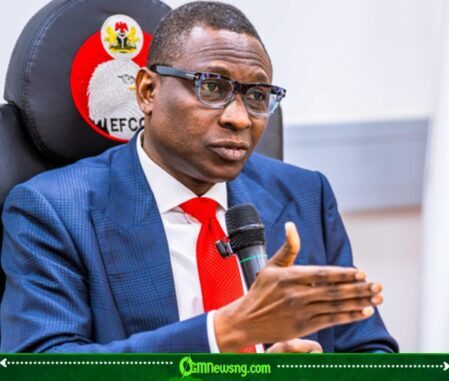
When Ola Olukoyede assumed office as Chairman of Nigeria’s Economic and Financial Crimes Commission (EFCC) in October 2023, he arrived with a promise that sounded simple enough to fit on a campaign banner: fight financial crimes without fear or favour and try something different. Nearly three years later, the scorecard suggests that the EFCC has indeed been busy—so busy, in fact, that alleged financial criminals may now need appointment books to keep track of their court dates. The latest stewardship report highlights thousands of convictions, massive asset recoveries and institutional reforms, turning the anti-graft agency into something resembling a combination of detective bureau, auction house and national lost-and-found office.
The Numbers Are Talking, and They Sound Slightly Exhausted
According to Olukoyede’s latest account of his stewardship, the EFCC received 49,673 petitions between October 2023 and July 2026, investigated 39,615 cases, filed 14,476 cases in court and secured 10,872 convictions—a conviction-to-filing ratio of 75.1 per cent. The Commission also reported recovering more than ₦1.23 trillion and about $684 million, alongside other foreign currencies and assets. At this point, one might reasonably ask whether the EFCC headquarters needs a bigger calculator or simply a stronger vault.
The figures represent a major development in Nigeria’s long-running war against economic and financial crimes. Olukoyede has repeatedly argued that enforcement alone is not enough, placing greater emphasis on prevention, fraud-risk assessment, institutional reform and improved internal controls. In other words, the EFCC appears to be saying that catching the thief is important, but perhaps locking the door before the thief arrives is not such a bad idea either.
A New EFCC Formula: Catch Them, Recover It, Then Prevent the Next One
Beyond arrests and prosecutions, the Olukoyede-led EFCC has pursued structural reforms, including fraud-risk assessment mechanisms, revised procedures on arrest and bail, digitalisation of operations and specialised responses to cyber-enabled financial crimes. The Commission has also expanded its presence with additional directorates and strengthened internal ethics structures—an important move for an agency whose job is to investigate misconduct without becoming part of the evidence itself.
Satire aside, the importance of the three-year report lies in the broader question of whether Nigeria’s anti-corruption campaign can move beyond dramatic arrests and sensational headlines toward lasting prevention and stronger institutions. Recovering stolen wealth is useful, but preventing public and private resources from disappearing in the first place may be even more valuable. The real test for Olukoyede and the EFCC will be whether these reforms survive personalities, political pressure and the Nigerian tradition of discovering loopholes almost immediately after they have been closed.
As the EFCC enters another phase under Olukoyede’s leadership, Nigerians will be watching closely—not only for bigger recovery figures and more convictions, but for evidence that the anti-graft war is becoming harder to manipulate and easier to trust. For now, the numbers are impressive, the promises remain ambitious, and OGM News NG will continue monitoring whether Nigeria’s financial criminals are genuinely running out of hiding places—or simply becoming more creative at decorating them.
Table of Contents
Discover more from OGM News NG
Subscribe to get the latest posts sent to your email.