







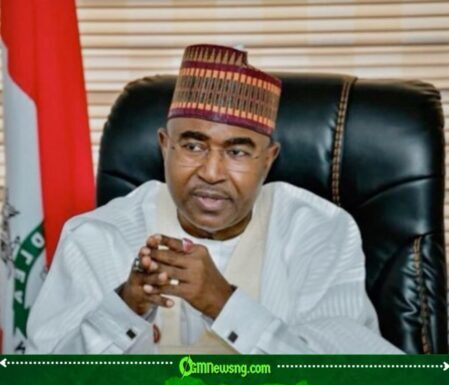
Marwa Urges Stronger Action Against Financial Assets of Drug Barons. The Chairman and Chief Executive Officer of the National Drug Law Enforcement Agency (NDLEA), Brig. Gen. Mohamed Buba Marwa (retd.), has delivered a message that could make alleged drug traffickers check their bank balances twice: arresting them may not be enough if their wealth remains available to keep the criminal business alive. Speaking at the 43rd Cambridge International Symposium on Economic Crime in the United Kingdom, Marwa argued that the fight against drug trafficking must go beyond handcuffs and court appearances to the recovery of the proceeds allegedly generated by crime.
Marwa Says Arrests Alone Cannot Defeat Drug Trafficking
In the satirical interpretation of Marwa’s warning, a drug baron who gets arrested but somehow keeps his fortune could theoretically leave prison with one major asset still working overtime: his money. The NDLEA chairman told the international gathering that the effectiveness of criminal justice should not be measured only by convictions but also by whether crime has actually been made unprofitable. In other words, according to the argument, putting the criminal behind bars while allowing the financial machinery to remain untouched may amount to winning the battle while leaving the battlefield fully operational.
Marwa compared such an approach to cutting a weed while leaving its roots untouched. That comparison has supplied enough material for satire: apparently, the criminal justice system cannot afford to celebrate the arrest while the alleged fortune is somewhere outside the courtroom quietly updating its business plan. The NDLEA says it has consequently strengthened financial investigations and asset-recovery measures alongside conventional enforcement operations.
Why Marwa Wants Drug Barons to Lose Their Money, Not Just Their Liberty
The agency says its strategy is anchored on the NDLEA Act 2004, the Proceeds of Crime (Recovery and Management) Act 2022 and the Money Laundering (Prevention and Prohibition) Act 2022. Marwa cited the recovery and sale of the Hook Hotel for $4.2 million as one example of the approach, with the proceeds paid into the Federal Government’s forfeited-assets account. He also disclosed that the agency had frozen more than $7 million in bank accounts in the previous month and obtained interim forfeiture orders involving multibillion-naira assets allegedly connected to a fugitive methamphetamine syndicate.
The broader message is straightforward: arresting suspects is one part of the operation, but disrupting the financial structure that allegedly supports trafficking is another. Marwa also highlighted cooperation between NDLEA investigators and prosecutors from the early stages of cases, preservation of asset value and the use of professional managers for some properties pending trial. He acknowledged challenges including delays in international legal assistance, limited forensic-accounting capacity and the need to protect the rights of accused persons while assets are preserved.
For now, the Cambridge message has shifted attention from the traditional question of “Who did the police arrest?” to the more financially uncomfortable question of “Where did the alleged criminal proceeds go?” And if Marwa’s position becomes increasingly embedded in Nigeria’s anti-drug strategy, the next chapter of the story may involve fewer dramatic handcuff moments and considerably more interest in bank accounts, companies, buildings, vehicles and other assets. OGM News NG will continue watching the developments as the battle against drug trafficking increasingly follows the money.
Table of Contents
Discover more from OGM News NG
Subscribe to get the latest posts sent to your email.