

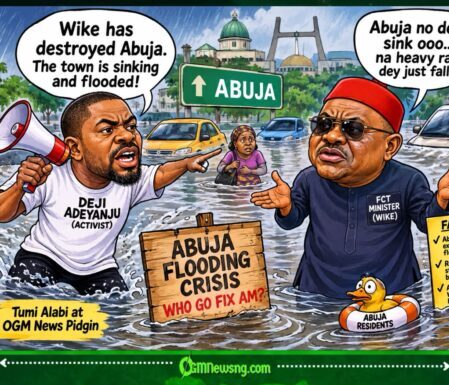
Flooding don become another big political and public infrastructure argument for Abuja, after activist and lawyer Deji Adeyanju reportedly called out Federal Capital Territory Minister Nyesom Wike over recent flooding in parts of the capital. Adeyanju’s description of Abuja as a city that is “sinking” na strong political statement, but the recent scenes of floodwater taking over roads have given the argument enough seriousness to demand proper questions — especially as rainy season continues.
Flooding: Adeyanju Accuses Wike of Turning Abuja Into Sinking Capital
According to the material provided to OGM News Pidgin, Adeyanju accused Wike of destroying Abuja and argued that the capital is sinking and flooding following recent rainfall. The allegation is clearly the activist’s assessment and should not be treated as an established official finding that the entire FCT has been destroyed. But the underlying issue — flooding — no be imaginary matter.
Recent reports from Abuja show say heavy rainfall has caused serious flooding in areas such as Wuye, where floodwater reportedly covered a major road close to Wuye International Market and Family Worship Centre. The situation created serious traffic congestion, with some vehicles stranded and residents complaining about blocked drainage channels. (NUJ FCT)
Adeyanju’s criticism also fits into a longer pattern of his public disagreements with Wike over FCT governance. In previous years, the activist had criticised the minister over demolitions, insecurity and urban-development decisions. In January 2026, Adeyanju also raised concerns over development around a designated green area in Maitama Extension, alleging that developers were converting a canal into a road — a development he warned could worsen flooding and environmental problems.
For Abuja residents, the matter therefore goes beyond political exchange. When drainage blocks, waterways are altered or development does not properly account for stormwater, heavy rain fit quickly turn ordinary roads into dangerous waterways. At that point, nobody really cares whether the argument start from APC, PDP, activist or minister — everybody just wants dry road.
Abuja Flooding: Adeyanju Questions Wike as Roads Turn to Rivers
The broader picture shows that the FCT Administration itself recognises drainage and flood control as infrastructure priorities. In February 2026, Wike inspected ongoing drainage, sewer and road works around the World Trade Center and Abuja Metro Rail corridor, with the stated objective of improving stormwater control and reducing traffic problems.
Other infrastructure projects have also included drainage work. In June 2026, the FCT Administration highlighted projects in satellite towns, including drainage and other infrastructure, while Wike said the administration was preparing to commission more than 30 projects across the Territory. (State House Abuja)
But there is an important difference between having drainage projects and having a city that never floods. Urban flooding can involve several factors at the same time, including intense rainfall, blocked or undersized drainage, poor maintenance, construction around waterways, land-use changes and the natural characteristics of particular locations. Nigeria’s federal authorities have also acknowledged flooding as a national challenge. The 2026 Annual Flood Outlook was presented with an emphasis on early warning, preparedness and mitigation, while the National Economic Council approved ₦83.2 billion for anticipatory interventions against flooding and other climate-related emergencies. (Ministry of Information)
So, while Adeyanju’s claim that Wike has “destroyed Abuja” remains an allegation and political criticism rather than an independently established fact, the recent flooding gives residents a legitimate reason to demand answers. The key questions should be whether drainage projects are being properly designed, completed and maintained; whether waterways are protected; whether known flood-prone locations are receiving priority; and whether residents are getting timely warnings during extreme rainfall.
Abuja has also seen substantial road and infrastructure activity under Wike, meaning the debate cannot honestly be reduced to the simple claim that “nothing is happening.” At the same time, completed roads and flashy projects cannot by themselves settle the flooding question. If motorists still need to calculate rainfall before entering certain streets, then infrastructure planning still has work to do.
The current controversy therefore deserves less political shouting and more measurable evidence. Adeyanju has raised an alarm; the FCT Administration has pointed to ongoing infrastructure investments; residents have their own experience whenever rain starts. The real test for flooding in Abuja no be who wins the argument online, but whether the capital can withstand the next serious downpour without roads turning into temporary rivers. OGM News Pidgin go continue to monitor developments as more information emerge.
Table of Contents
Discover more from OGM News NG
Subscribe to get the latest posts sent to your email.