



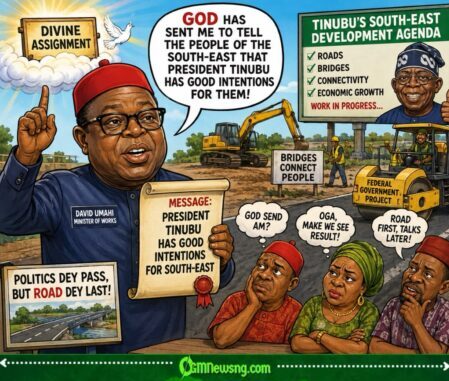
Tinubu’s South-East message don enter another level after Minister of Works David Umahi said he believes God sent am to tell the people of the region that President Bola Tinubu get good intentions for them. The statement fit sound spiritual, political and infrastructural at the same time, but underneath the drama dey one serious question: wetin exactly government dey do for the region, and how much of those projects people fit actually feel for their daily lives?
Umahi has faced criticism for openly defending the Tinubu administration, but the minister no appear ready to retreat. Instead, he dey point toward federal road and bridge projects as evidence that the South-East dey receive attention under the current administration. For Nigerians wey dey observe politics, the combination of “God send me,” Tinubu endorsement and infrastructure talk don naturally create plenty room for debate.
Tinubu, South-East and Umahi’s Message
The original claim centres on Umahi’s conviction that President Tinubu is committed to integrating the South-East into the Federal Government’s development agenda. The minister has urged residents to look beyond political sentiments and recognise ongoing projects. His argument be say government intention should not only be judged through political alignment but also through what dey happen physically on the ground.
That position no come from empty road. In recent months, Umahi has repeatedly highlighted federal infrastructure in Ebonyi and other parts of the South-East. During a June 2026 inspection, he identified the Calabar–Ebonyi–Benue Trans-Sahara Superhighway as one major project expected to improve connectivity between the South-East, South-South and North-Central regions. Federal officials also said work on one section had passed 28 per cent, with construction continuing during the rainy season through concrete technology. (Ministry of Information)
The minister has also made political support for Tinubu part of his broader argument. In May, federal officials reported that Umahi urged South-East leaders to acknowledge Tinubu’s interventions and support his re-election bid in 2027. In June, the Federal Ministry of Works similarly described the projects as evidence that the South-East had been included in federal infrastructure investments. (Ministry of Information)
And na here the matter get small pepper. Government project fit be evidence of development, but e no automatically mean say every citizen must agree with government politically. Road construction, bridge rehabilitation and economic connectivity can be measured by completion, quality, cost, accessibility and impact—not simply by the number of political endorsements the project generates.
Umahi Tells South-East to See Tinubu’s Projects Before Political Sentiments
The Tinubu administration’s South-East infrastructure argument has some concrete details behind am. The Federal Ministry of Works says the Calabar–Ebonyi–Benue–Kogi–Nasarawa–Abuja corridor forms part of a wider infrastructure strategy intended to connect different parts of Nigeria and improve economic activity. In June, officials said Section One of the Trans-Sahara Superhighway had been expanded from an original 118 kilometres to 123.6 kilometres, with dualisation being pursued. (State House of Nigeria)
Other projects highlighted by the ministry include the Timber Shade–Afikpo Road, Edda Road, Ndibe Beach–Afikpo–Cross River Bridge axis and the Onueke Flyover. The ministry has said these projects are expected to reduce travel time, improve safety, strengthen regional connectivity and create opportunities for agriculture and trade. One federal update also reported that about eight kilometres of the first phase of the Edda Road had been completed during an earlier inspection. (Ministry of Information)
The Enugu–Port Harcourt corridor has also featured prominently in Umahi’s defence of the administration. In an earlier inspection, he said work was ongoing along the route and argued that appointing a South-Easterner as Works Minister itself demonstrated that Tinubu had intentions toward the region. He also urged residents to avoid what he described as non-strategic political moves ahead of 2027.
But the wider context deserves balance. Infrastructure announcements are not the same thing as completed infrastructure. Contracts still need funding, contractors need supervision, projects need to meet specifications and communities ultimately need to experience the promised benefits. The Federal Ministry itself has acknowledged issues around project financing and implementation in different corridors, meaning citizens are justified in asking not only “Who approve the road?” but also “When e go finish, how much e cost and how e go affect us?”
The Tinubu government therefore has a clear opportunity to turn the South-East infrastructure debate from political argument into measurable performance. If the roads finish properly, bridges become dependable and transport links genuinely reduce the cost of moving people and goods, the projects themselves will make the strongest case. Umahi may say God sent him with the message, but ultimately, na completed roads, working bridges and improved economic opportunities go deliver the loudest message to the South-East.
Table of Contents
Discover more from OGM News NG
Subscribe to get the latest posts sent to your email.