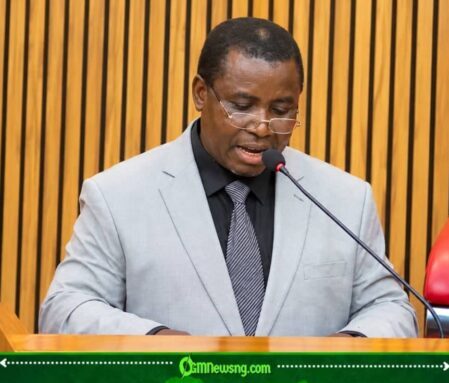









Security Agencies have moved to the center of national debate after Apostle Johnson Suleman declared that Nigeria’s military, police, and Department of State Services are among the finest he has encountered globally, while simultaneously arguing that the country’s insecurity crisis persists because alleged Terror Sponsors remain insufficiently targeted. His remarks have reignited discussions about the effectiveness of security institutions, political accountability, and the hidden networks that may sustain violent groups operating across parts of Nigeria.
The comments arrive amid continuing security concerns involving insurgency, banditry, kidnappings, and communal violence. While public criticism of security institutions remains common, Suleman offered a sharply different perspective, insisting that many of the country’s security challenges cannot be blamed solely on frontline operatives.
Cleric Defends Military, Police and DSS Amid Security Agencies Concerns
According to Suleman, Nigeria’s Security Agencies possess significant operational capabilities and continue to make sacrifices in difficult and dangerous environments. Drawing from his international travel experiences, he stated that the military, police, and DSS compare favorably with security organizations in many countries. He argued that the public often overlooks the daily risks undertaken by personnel confronting terrorists, insurgents, and other criminal groups.
The cleric particularly defended the DSS, noting that intelligence operations frequently occur outside public view. In a subtle criticism of modern expectations, he suggested that not every arrest, disruption, or intelligence success can be displayed publicly like a social media update. In his view, constant ridicule of Security Agencies may discourage personnel whose work already involves considerable danger and limited public recognition.
Terror Sponsors, Not Soldiers, Are Nigeria’s Biggest Problem—Suleman
Beyond praising security institutions, Suleman focused heavily on Terror Sponsors, repeatedly urging authorities to identify and prosecute those who allegedly finance or empower violent actors. His argument reflects a position increasingly echoed by security analysts who contend that dismantling funding networks is often as important as defeating armed groups in direct combat. He maintained that arresting fighters alone may not permanently solve insecurity if financial and logistical backers remain untouched.
His remarks also touched on broader policy debates. Suleman advocated ranching as an alternative to open grazing and argued that political leaders should place national security above partisan calculations. Recent security discussions within Nigeria have frequently emphasized intelligence gathering, financial tracking, border management, and community-based interventions as complementary tools in the fight against violent extremism. Against that backdrop, his emphasis on pursuing Terror Sponsors aligns with broader calls for stronger investigations into the structures that sustain insecurity beyond the battlefield itself.
The intervention has generated attention not merely because of the praise directed at Security Agencies but because of the challenge issued to political leaders. Whether one agrees with his assessment or not, the comments have once again raised a critical question: if Security Agencies personnel are capable and committed, as he argues, then how much of Nigeria’s security crisis depends on confronting Terror Sponsors, strengthening institutions, and ensuring political will matches public promises? OGM News Nigeria will continue monitoring reactions and developments surrounding this debate as it evolves.
Table of Contents
Discover more from OGM News NG
Subscribe to get the latest posts sent to your email.