




Nigeria’s ruling All Progressives Congress (APC) has rejected allegations that it is responsible for the internal crises plaguing opposition parties, insisting instead that such challenges are self-inflicted. The party also maintained that democracy remains firmly on course under President Bola Tinubu, despite mounting criticism from rival political groups.
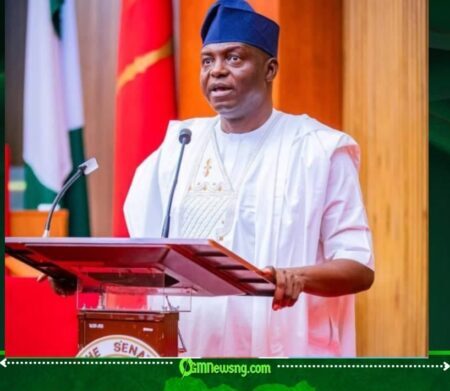
Speaking during a live media chat in Abuja, APC National Chairman, Nentawe Yilwatda, alongside National Secretary, Ajibola Basiru, defended the administration’s record. They argued that the ruling party remains focused on governance while opposition parties struggle with internal divisions ahead of the 2027 general elections.
Opposition Parties Face Deepening Internal Divisions
Major opposition platforms, including the African Democratic Congress (ADC) and the Peoples Democratic Party (PDP), are currently grappling with leadership disputes that have fractured their national structures. These divisions have triggered multiple legal battles, raising concerns about their readiness for the next electoral cycle.
Tensions escalated following the decision of the Independent National Electoral Commission (INEC) to derecognise certain ADC leaders. In response, figures such as David Mark criticised the electoral body and accused the Tinubu administration of interference, a claim the APC has firmly denied.
At a recent ADC convention in Abuja, prominent political figures, including Atiku Abubakar, Rotimi Amaechi, Peter Obi, and Rabiu Kwankwaso, alleged that the Federal Government was attempting to weaken opposition parties. They also criticised the administration’s handling of the economy and security.
APC Rejects Blame, Defends Democratic Principles
Responding to the allegations, Basiru emphasised that Nigeria’s democracy remains vibrant, citing the existence of multiple political parties and the freedom of expression as evidence. He argued that only a small fraction of registered parties are experiencing crises, suggesting internal mismanagement rather than external interference.
Basiru further pointed to ongoing court cases involving opposition factions, noting that judicial rulings—rather than political pressure—have shaped recent developments. He questioned claims that the APC was orchestrating disputes within rival parties, asking whether any member of the ruling party had directly interfered in their internal processes.
He also cautioned opposition leaders against undermining democratic institutions, particularly the judiciary, for political gain. According to him, adherence to legal processes and internal party discipline remains essential for sustaining democratic order.
Security and Governance: APC Highlights Progress
On the issue of national security, Basiru acknowledged ongoing challenges but insisted that measurable progress has been made. He cited the prosecution of hundreds of suspects linked to insecurity and emphasised the complexity of insurgency, particularly in regions where combatants blend with civilian populations.
He called for a collective national approach, urging communities, state governments, and federal authorities to collaborate more effectively. Basiru also advocated reforms within the policing system, including decentralisation and improved operational capacity, to better address Nigeria’s security demands.
The APC maintained that security should not be politicised, stressing that long-term solutions require both kinetic and non-kinetic strategies, including community engagement and cutting off funding sources for criminal networks.
Economic Reforms and the Path Forward
Yilwatda defended the administration’s economic policies, describing them as bold but necessary steps toward long-term stability. He highlighted improvements in macroeconomic indicators, including increased government revenues, GDP growth, and stronger foreign reserves.
According to him, these gains are already enabling infrastructure development across states without excessive borrowing. He noted that tax revenues have reached unprecedented levels, reflecting what he described as a more efficient fiscal environment.
However, he acknowledged that the benefits of these reforms have yet to fully translate to the grassroots. The APC leadership stated that efforts are ongoing to strengthen the microeconomic environment through social interventions, including student loans and targeted support for vulnerable populations.
The APC’s response underscores a widening political divide as Nigeria approaches the 2027 elections. While the ruling party insists that opposition challenges stem from internal failures, critics continue to question the broader political environment and the administration’s policies.
As legal battles persist and political rhetoric intensifies, the state of Nigeria’s democracy—and the strength of its opposition—remains a focal point of national discourse.
Table of Contents
Discover more from OGM News NG
Subscribe to get the latest posts sent to your email.