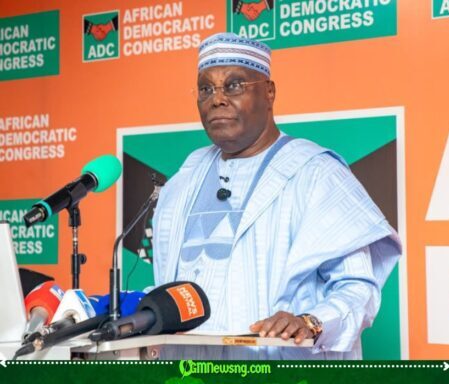









Former Vice President Atiku Abubakar has called on opposition political parties to unite in pushing for a transparent and credible electoral process, warning that Nigeria’s current plan to combine electronic and manual transmission of election results could create confusion and undermine public trust. Speaking at a press briefing in Minna, Niger State, Atiku said Nigerians expect a clear, real-time electronic system and cautioned that a mixed approach risks operational chaos during elections.
Atiku Call for a Single-Tier Electronic Transmission System
Atiku’s remarks followed a closed-door meeting with former Military President, General Ibrahim Babangida, after which he addressed journalists on the state of Nigeria’s electoral reforms. He argued that the expectations of voters are firmly set on real-time electronic transmission of results from polling units to collation centres, a process he said would enhance transparency and reduce disputes.
According to him, the current arrangement—combining electronic transmission with manual collation—creates uncertainty for both voters and election officials. He maintained that a single-tier, fully electronic system would be clearer and more efficient, helping to eliminate ambiguities that often arise during result collation.
Atiku therefore urged opposition parties to close ranks and collectively advocate reforms that would strengthen the credibility of elections. He said such unity is necessary to ensure that electoral laws reflect the will of Nigerians and meet global standards for democratic processes.
Atiku’s Concerns Over Senate’s Amendment to the Electoral Act
The former Vice President expressed dissatisfaction with the Senate’s recent adoption of the amended Clause 60(3) of the Electoral Act, which permits electronic transmission of results but retains manual collation as a backup where technology fails. While acknowledging the provision as a compromise, Atiku described it as inadequate for guaranteeing full transparency.
He criticised the decision not to make electronic transmission compulsory and the rejection of real-time upload of results, arguing that these omissions weaken confidence in the process. In his view, settling for a hybrid system risks perpetuating the very challenges the reforms were meant to resolve.
Atiku insisted that opposition parties should not accept the amendment as final, stressing that sustained advocacy is required to secure a clearer and more accountable framework for elections.
Political Positioning and Party Structure Ahead of 2027
Addressing questions about his visit to Minna and speculations about the 2027 presidential election, Atiku dismissed suggestions that his presence signalled early campaigning. He said he has a long-standing relationship with the city and often visits to pay respects, adding that discussions about the 2027 race are premature.
He clarified that his current focus is on strengthening the African Democratic Congress (ADC), noting that the party is working to build solid structures from the ward level up to the national level. He also said the party is actively mobilising members and expanding its registration drive.
On zoning, Atiku noted that the ADC does not have zoning provisions in its constitution, adding that among major parties, only the Peoples Democratic Party (PDP) formally recognises zoning. His comments came against the backdrop of the Senate’s emergency plenary, which reconsidered contentious provisions in the Electoral Act Amendment Bill, ultimately approving electronic transmission to the Independent National Electoral Commission’s Result Viewing Portal while retaining manual collation as a fallback.
Table of Contents
Discover more from OGM News NG
Subscribe to get the latest posts sent to your email.