








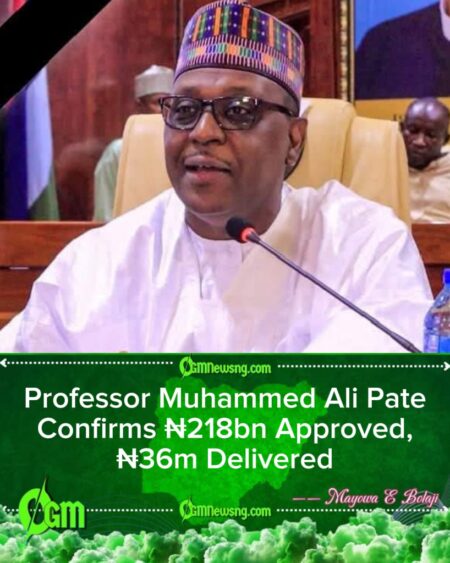
Professor Muhammed Ali Pate, Nigeria’s Minister of Health and Social Welfare, has raised a red flag over the alarming release of funds allocated to the health sector in the 2025 budget.According to Professor Muhammed Ali Pate, only ₦36 million has so far been released from the total ₦218 billion capital budget, exposing a massive gap between government allocation and actual implementation. The revelation has triggered concern across Nigeria’s health ecosystem, including hospital managers, medical professionals, and policy experts.
Speaking on the state of budget implementation, Professor Muhammed Ali Pate described the situation as a serious constraint on the ministry’s ability to deliver on its mandate. Capital budget provisions are designed to fund long-term investments such as hospital construction, rehabilitation of aging health facilities, and acquisition of modern medical equipment. However, with less than one percent of the approved funds released, most planned projects remain at a standstill.
Health sector analysts warn that the funding shortfall highlighted by Professor Muhammed Ali Pate could further weaken Nigeria’s already fragile healthcare system. They note that delayed or nonexistent capital releases often translate into abandoned projects, overcrowded hospitals, and declining quality of care, particularly for vulnerable populations in rural and underserved areas.
Professor Muhammed Ali Pate Explains Impact on Hospitals and Health Infrastructure
Professor Muhammed Ali Pate explained that the limited release of capital funds has had a direct and negative impact on federal hospitals, teaching institutions, and specialized medical centers across the country. Many of these facilities rely on capital funding to upgrade equipment, expand service delivery, and maintain essential infrastructure such as electricity, water supply, and health information systems.
According to Professor Muhammed Ali Pate, the current ₦36 million release is grossly inadequate to address the pressing infrastructure deficits facing the health sector. He stressed that without sustained capital investment, hospitals will continue to struggle with outdated technology, limited bed capacity, and poor working conditions for health professionals. This, he warned, could accelerate the migration of skilled medical workers and worsen patient outcomes.
The situation also threatens Nigeria’s commitment to Universal Health Coverage (UHC). Professor Muhammed Ali Pate noted that achieving UHC depends heavily on strong health infrastructure and functional referral systems. When capital projects are stalled, access to quality and affordable healthcare becomes increasingly difficult, undermining national efforts to reduce maternal mortality, control infectious diseases, and manage non-communicable illnesses.
Professor Muhammed Ali Pate Calls for Urgent Reforms and Budget Discipline
In response to the funding gap, Professor Muhammed Ali Pate has called for urgent improvements in budget execution and fiscal discipline. He emphasized that approving large allocations without releasing funds weakens public trust and limits the government’s ability to deliver tangible results. According to him, healthcare financing should be treated as a national priority rather than a discretionary expense.
Professor Muhammed Ali Pate also reaffirmed the federal government’s commitment to health sector reforms, including improved accountability, efficient use of available resources, and exploration of alternative funding models. He disclosed that the ministry is engaging development partners, private investors, and multilateral institutions to supplement limited government funding through blended finance and public-private partnerships.
As discussions around the 2025 budget continue, Professor Muhammed Ali Pate urged policymakers and financial authorities to urgently close the gap between budget approval and fund release. He warned that failure to act decisively could deepen Nigeria’s health challenges, delay critical infrastructure development, and compromise the country’s long-term public health and economic stability.
Table of Contents
Discover more from OGM News NG
Subscribe to get the latest posts sent to your email.