







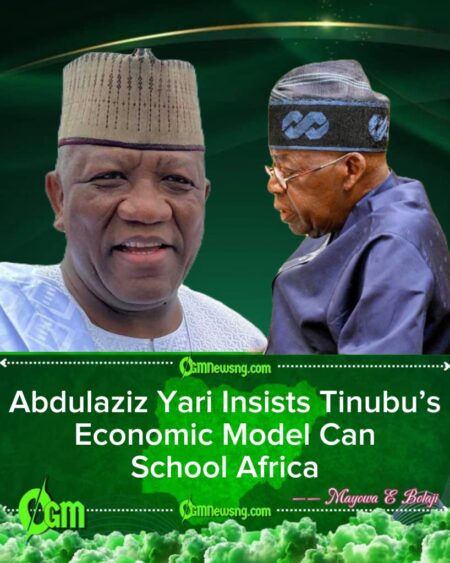
Abdulaziz Yari, former Zamfara State Governor and Senator, has described President Bola Ahmed Tinubu’s ongoing economic reforms as a model that other African countries can adopt, insisting that Nigeria’s policy direction under the current administration reflects long-term strategic thinking rather than short-term populism. Yari made the remarks while responding to criticisms surrounding subsidy removal, fiscal tightening, and broader economic restructuring.
Abdulaziz Yari Defends Tinubu’s Economic Reforms Amid Public Backlash
Abdulaziz Yari said President Tinubu inherited an economy weakened by years of structural distortions, heavy subsidies, and unsustainable fiscal practices. According to him, the current administration had little choice but to take bold and sometimes painful decisions to stabilize the economy and restore investor confidence.
He argued that while many Nigerians are feeling the immediate impact of the reforms, history has shown that meaningful economic transformation rarely comes without sacrifice. Yari maintained that Tinubu’s approach reflects a willingness to confront deep-rooted problems that previous governments avoided due to political considerations.
The senator stressed that criticism should be balanced with patience, noting that economic reforms are processes, not events. He added that judging Tinubu’s policies solely by short-term hardship ignores their long-term benefits for growth, employment, and macroeconomic stability.
Why Tinubu’s Reform Agenda Is a Model for Africa — Yari
Abdulaziz Yari explained that Tinubu’s economic reforms address issues common across many African economies, including fuel subsidies, weak revenue generation, currency distortions, and overdependence on government spending. He said these challenges are not unique to Nigeria, making the reforms relevant beyond the country’s borders.
According to Yari, Tinubu’s decision to remove fuel subsidies and allow market-driven pricing reflects economic realism that many African leaders struggle to embrace. He noted that subsidy regimes across the continent have often benefited elites while draining public resources meant for infrastructure, health, and education.
Yari further stated that Nigeria’s size and influence make its economic policies a potential reference point for other African nations. If successfully implemented, he said, Tinubu’s reforms could serve as a case study for how large African economies can pursue sustainability without collapsing under political pressure.
Long-Term Gains and the Road Ahead for Nigeria and Africa
Abdulaziz Yari expressed confidence that Tinubu’s economic reforms would yield positive results over time, particularly in revenue growth, foreign investment, and job creation. He said early indicators, including renewed investor interest and fiscal adjustments, suggest that the reforms are beginning to correct long-standing imbalances.
He also emphasized the need for complementary social policies to cushion the impact of reforms on vulnerable Nigerians. According to Yari, economic restructuring must go hand in hand with targeted social interventions to ensure inclusiveness and public trust.
Concluding his remarks, Abdulaziz Yari urged Nigerians to look beyond immediate discomfort and focus on the broader vision of economic stability and continental leadership. He maintained that President Tinubu’s reform agenda, if sustained, could reposition Nigeria as a benchmark for economic reform in Africa, setting an example for responsible governance and policy discipline.
Table of Contents
Discover more from OGM News NG
Subscribe to get the latest posts sent to your email.