









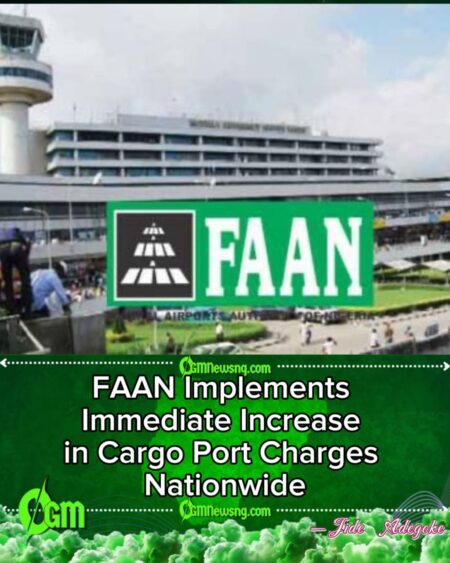
The Federal Airports Authority of Nigeria (FAAN) has announced an upward review of cargo port charges, increasing the fee from N7 to N20 with immediate effect. The adjustment, which applies across affected airport cargo operations nationwide, marks a significant change in the cost structure for importers, exporters, and logistics operators that rely on Nigeria’s air cargo facilities.
The development comes amid ongoing efforts by public agencies to reposition infrastructure funding and improve service delivery at the nation’s airports. While FAAN has not released extensive operational details alongside the announcement, the new rate is already in force, prompting swift reactions across the aviation and trade sectors.
Details of the New Tariff Regime
FAAN’s decision raises the cargo port charge by nearly threefold, moving from N7 to N20 per applicable unit. The authority confirmed that the revised charge takes effect immediately, leaving no transition window for operators with consignments already in process. Cargo handlers and freight forwarders are therefore required to comply with the new rate without delay.
Industry stakeholders note that cargo port charges form part of the cumulative costs associated with air freight, alongside handling fees, storage charges, and customs-related payments. As such, even a seemingly modest adjustment can have a ripple effect on the final cost of goods, particularly for time-sensitive or high-volume cargo.
Although FAAN has yet to publish a detailed breakdown or justification for the increase, similar reviews in the past have been linked to rising operational costs, infrastructure maintenance, and the need to upgrade airport facilities to international standards.
Implications for Trade and Aviation Stakeholders
The immediate implementation of the new charge has drawn attention from importers, exporters, and logistics companies, many of whom operate on tight margins. Freight forwarders warn that higher cargo port charges may be passed on to end users, potentially increasing prices for goods transported by air.
Air cargo plays a critical role in Nigeria’s economy, particularly for pharmaceuticals, perishable goods, and high-value exports.
Stakeholders argue that policy consistency and adequate consultation are essential to avoid disruptions in supply chains and to maintain Nigeria’s competitiveness as a regional aviation hub.
Some aviation analysts, however, suggest that if the additional revenue is transparently reinvested in cargo infrastructure, security, and efficiency, the long-term benefits could outweigh the short-term cost pressures faced by operators.
Reactions and the Way Forward
Early reactions within the aviation community have been mixed. While some stakeholders acknowledge FAAN’s responsibility to sustain airport operations, others have called for clearer communication and engagement with industry players to explain the rationale behind the increase.
Trade groups are expected to seek further clarification from FAAN on the scope of the charge, its application, and whether additional adjustments may follow. In the coming days, industry consultations may shape how the new tariff is received and implemented across Nigeria’s airports.
As the policy takes effect, attention will remain on how FAAN balances revenue generation with the broader goal of supporting trade facilitation and economic growth through efficient air cargo operations.
Table of Contents
Discover more from OGM News NG
Subscribe to get the latest posts sent to your email.