

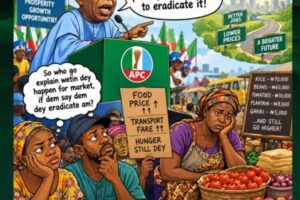








Senator Adams Oshiomhole has once again found himself at the center of national attention following his statement that “there are Nigerians now saying that food is becoming too cheap.” The remark, attributed to the former Edo State governor and current senator, immediately sparked intense discussion across Nigeria’s political and economic landscape. Given the sensitivity surrounding food prices, the statement quickly became a lightning rod for public reaction.
In a country where food inflation has remained a top concern for households, Adams Oshiomhole’s comment was widely interpreted as either a sign of economic optimism or a troubling disconnect from everyday realities. Many Nigerians continue to face rising costs of staple foods, making any suggestion of affordability a highly charged issue. As a prominent political figure, Oshiomhole’s words carried significant weight.
Supporters of Adams Oshiomhole argue that his statement may reflect localized market observations or early signs of policy impact in agricultural production and supply chains. Critics, however, insist that isolated improvements do not reflect the broader national experience, especially for urban poor and rural communities battling economic hardship.
Public Reaction to Adams Oshiomhole’s Statement
Public reaction to Adams Oshiomhole’s food price comment was swift and divided. On social media platforms, many Nigerians questioned the claim, sharing personal experiences of high food costs in markets across Lagos, Abuja, Port Harcourt, and other major cities. For these citizens, the remark reinforced perceptions of a widening gap between political leadership and everyday struggles.
Opposition politicians and civil society organizations also weighed in, using Adams Oshiomhole’s statement as a rallying point to criticize government economic messaging. Some described the comment as insensitive, while others called for leaders to ground public statements in verified economic data rather than anecdotal evidence. The phrase quickly became a reference point in political debates and media analysis.
Conversely, some economists and political commentators urged caution against literal interpretation.
They suggested Adams Oshiomhole may have been highlighting relative price drops in specific commodities or regions. According to this view, the controversy reflects broader challenges in communicating complex economic trends to a diverse population experiencing uneven economic outcomes.
What Adams Oshiomhole’s Comment Means for Policy and Governance
Beyond the immediate backlash, Adams Oshiomhole’s statement has reopened broader conversations about food security, inflation control, and governance in Nigeria. Analysts note that food prices are not just economic indicators but emotional and political issues that directly affect public trust in leadership. Any perceived misalignment can quickly erode confidence in government policies.
The debate has also highlighted the need for transparent, nationwide food pricing data that reflects regional differences and household purchasing power. Experts argue that clearer data presentation could help contextualize statements made by leaders like Adams Oshiomhole and reduce public misunderstanding or backlash.
Ultimately, the controversy surrounding Oshiomhole underscores the importance of careful economic communication. As Nigeria continues to grapple with inflation and cost-of-living pressures, citizens are likely to judge leadership not by optimistic declarations, but by tangible improvements felt in markets and homes across the country.
Table of Contents
Discover more from OGM News NG
Subscribe to get the latest posts sent to your email.