


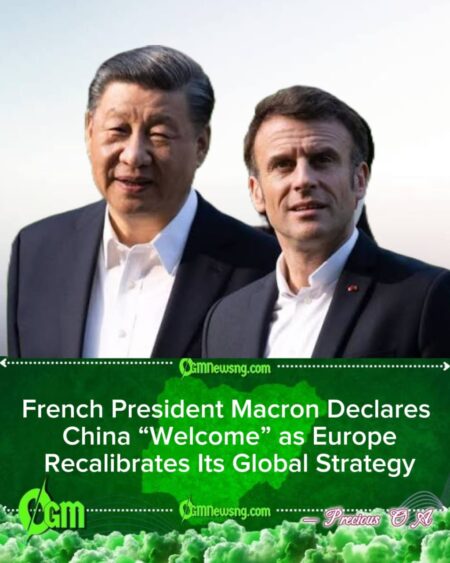
French President Macron declared that “China is welcome” in Europe during a high-profile address that immediately drew attention across diplomatic and economic circles. The statement was framed as an invitation for constructive engagement, emphasizing dialogue, trade, and shared responsibility in addressing global challenges. Observers noted that the language was deliberate, signaling openness without explicitly redefining Europe’s existing alliances.
The remarks came amid intensifying debates within the European Union over how to balance economic cooperation with strategic caution. Several member states have expressed differing views on Chinese investment, particularly in infrastructure, technology, and energy. Macron’s words appeared designed to project confidence in Europe’s ability to engage China on its own terms.
French President Macron also stressed that engagement does not equate to dependency, underscoring Europe’s intention to protect its strategic autonomy. He emphasized that partnerships must be reciprocal, transparent, and consistent with European values, a point aimed at reassuring both domestic audiences and transatlantic allies.
Economic Cooperation and Trade Dynamics
European businesses have long viewed China as both a vast market and a formidable competitor. Trade volumes between the EU and China remain significant, encompassing manufacturing, agriculture, and consumer goods. Macron’s statement was widely interpreted as support for maintaining open commercial channels.
French President Macron highlighted the importance of fair competition, arguing that European firms should have the same access to Chinese markets as Chinese companies enjoy in Europe. This principle of reciprocity has been a recurring theme in EU policy discussions and remains central to ongoing trade negotiations.
At the same time, policymakers continue to weigh safeguards against overreliance on any single external partner. Diversification of supply chains, particularly after recent global disruptions, has become a strategic priority across the continent.
French President Macron and Diplomatic Signaling
French President Macron used the moment to reaffirm France’s role as a leading diplomatic voice within Europe. By choosing inclusive language, he positioned France as an advocate for dialogue rather than confrontation, even amid geopolitical competition.
The message resonated differently across European capitals. Some leaders welcomed the emphasis on engagement, while others cautioned against underestimating security concerns tied to technology transfers and critical infrastructure. The varied reactions underscored the complexity of forging a unified European approach.
French President Macron maintained that Europe must speak with confidence and clarity, neither closing doors nor ignoring legitimate concerns. His comments suggested that diplomacy, when paired with firm standards, remains Europe’s preferred path forward.
Security and Strategic Autonomy
Security considerations continue to shape Europe’s posture toward China. Issues ranging from cybersecurity to maritime security in global trade routes have become increasingly prominent. Macron acknowledged these realities while arguing that dialogue can coexist with vigilance.
French President Macron reiterated Europe’s commitment to strengthening its own defense capabilities, framing strategic autonomy as a complement to international partnerships rather than a rejection of them. This perspective aligns with broader EU initiatives aimed at enhancing collective security.
Many analysts view this balance as critical: engaging China economically while ensuring that Europe retains control over sensitive sectors. The challenge lies in translating this principle into consistent policy across all member states.
Global Challenges and Multilateral Engagement
Climate change, public health, and financial stability were also referenced as areas where cooperation with China could yield tangible benefits. Europe and China share responsibilities as major global actors, particularly in emissions reduction and sustainable development.
French President Macron pointed to climate diplomacy as an example of constructive engagement, noting that progress often depends on collaboration among the world’s largest economies. Such cooperation, he argued, serves global interests without compromising national sovereignty.
Beyond climate issues, multilateral forums remain key venues for managing competition and cooperation alike. Europe’s approach emphasizes rules-based engagement, seeking to anchor relations within established international frameworks.
Looking Ahead for Europe–China Relations
French President Macron concluded by urging European leaders to approach the relationship with confidence rather than fear. He emphasized that openness, when guided by clear principles, can strengthen Europe’s global standing rather than weaken it.
The coming months are expected to test this approach as trade talks, regulatory decisions, and diplomatic exchanges continue. Europe’s ability to maintain unity while engaging a powerful partner will be closely watched by allies and competitors alike.
French President Macron framed the moment as an opportunity for Europe to define its role in a changing world. Whether this vision translates into lasting policy coherence will depend on how effectively European institutions and member states align their strategies moving forward.
Table of Contents
Discover more from OGM News NG
Subscribe to get the latest posts sent to your email.