








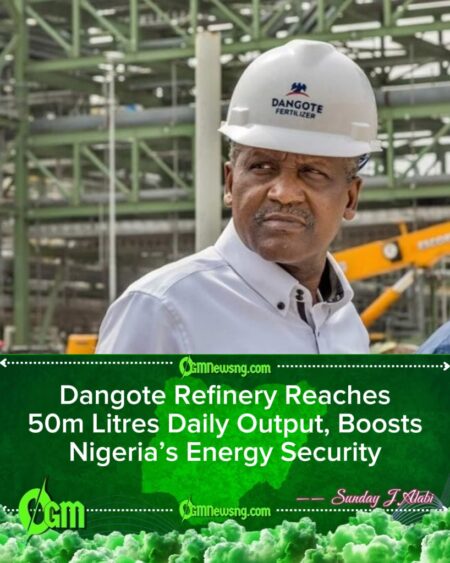
Nigeria’s long-running debate over fuel prices, foreign exchange pressure and economic stability received a significant development this week as Dangote Petroleum Refinery Plc announced it has achieved a daily offtake of 50 million litres of Premium Motor Spirit (PMS). The milestone positions the refinery as a central pillar in Nigeria’s downstream petroleum sector and marks a practical step toward energy self-sufficiency.
The announcement, made in Lagos by the company’s newly appointed Managing Director, David Bird, underscores growing operational stability at the world’s largest single-train refinery. According to the company, the achievement reflects not only increased production capacity but also a robust logistics and distribution system capable of moving large fuel volumes into the domestic market and, when necessary, for export.
Dangote Refinery Operational Scale and Supply Stability
Dangote Refinery’s attainment of 50 million litres in daily offtake represents a shift from theoretical capacity to real market impact. Bird explained that the refinery is now dispatching over 1,000 fuel trucks daily, a figure that demonstrates both production strength and effective offtake management. He noted that supply remained seamless during the Christmas and New Year holidays, a period traditionally marked by fuel scarcity in Nigeria.
While acknowledging that demand fluctuates—particularly between weekdays and weekends—Bird said the refinery has the flexibility to sustain volumes and export surplus fuel when domestic demand softens. On some days, he disclosed, output has exceeded 52 million litres, despite the Dangote refinery being in a stabilisation phase following the ramp-up of certain units in the second half of 2025.
He attributed this performance to the refinery’s design, describing it as a highly flexible merchant refining, blending and trading platform rather than a conventional single-crude refinery. This flexibility, he said, allows the plant to adjust its crude mix and output in response to market conditions, ensuring consistent supply.
World-Class Fuel Standards and Industrial Expansion
Beyond volume, Dangote Refinery says it is redefining fuel quality in Nigeria. Bird confirmed that the refinery is producing Euro 5 standard fuels—the same quality supplied to Europe and premium global markets such as Dubai. He criticised the long-standing practice of dumping substandard fuels in West Africa, noting that lower sulphur content translates into cleaner emissions and tangible public health benefits.
According to him, Nigeria’s transition to cleaner fuel represents a structural improvement in energy consumption standards and environmental outcomes. “Nigeria is now enjoying world-class fuel,” Bird said, adding that the refinery has the capacity to consistently meet European-grade specifications.
The Dangote refinery’s ambitions extend beyond fuel. It currently operates an 800,000-tonne polypropylene plant and plans to scale output to 2.4 million tonnes through additional Propane Dehydrogenation (PDH) units. Future diversification may include detergents, base oils, lubricants and Liquefied Petroleum Gas (LPG), driven by import substitution and population-led demand. Steel structures for the next phase of expansion are expected to begin rising before the end of 2026.
Policy Support, Competition and Market Implications
Dangote Refinery also highlighted the role of government policy in supporting its operations, particularly the Federal Government’s Naira-for-Crude initiative introduced in October 2024. Bird said between 30 and 40 per cent of the refinery’s crude supply currently comes through the programme, with the remainder sourced from Nigerian spot purchases and international grades.
Even at current levels, he said, the policy has contributed significantly to naira stabilisation by reducing dollar demand. He added that the Dangote refinery could absorb additional allocations if the programme is expanded, arguing that domestic refining helps shield Nigeria from global geopolitical and supply shocks.
Addressing claims of anti-competitive behaviour, Bird dismissed suggestions that the refinery favours specific marketers or controls pump prices. He said all customers purchase PMS at a uniform ex-depot price of ₦699 per litre and that retail pricing decisions are solely the responsibility of marketers in Nigeria’s deregulated downstream market.
Implications for Nigeria and Regional Markets
Reaching 50 million litres in daily offtake moves Dangote Refinery from promise to infrastructure reality. For Nigeria, the implications are far-reaching. Domestic refining reduces reliance on imported fuel, eases pressure on foreign exchange reserves, and weakens the link between global disruptions and local pump prices.
The Dangote refinery’s export capability also positions Nigeria as a potential regional energy hub. With West and Central Africa heavily dependent on imported refined fuel, consistent output from Nigeria could support regional supply, strengthen intra-African trade and align with the objectives of the African Continental Free Trade Area (AfCFTA).
Ultimately, the milestone reinforces Nigeria’s transition from a major crude oil exporter to a more influential downstream player—one capable of shaping fuel standards, market stability and industrial growth across the continent.
Table of Contents
Discover more from OGM News NG
Subscribe to get the latest posts sent to your email.