









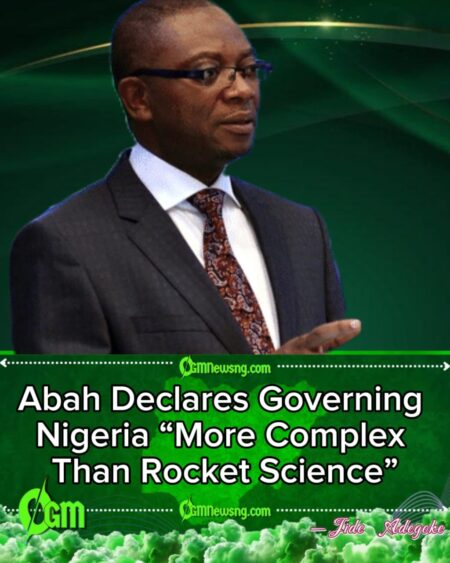
Abuja — At a high-profile governance forum in the capital on Tuesday, seasoned Nigerian public governance expert Dr. Joe Abah made a striking assertion: the art and practice of governing a country surpass even the complexity of rocket science. Speaking as keynote speaker at the Hadiza Bala Usman @50 Governance Colloquium held at the Transcorp Hotel, Abah underscored that the core challenge in public leadership does not lie in technical aptitude but in navigating the multifaceted realities of power, politics and people.
Drawing from decades of governance experience in public service and policy advisory, Abah explained that while rockets operate within predictable scientific laws, public governance involves delicate balances between competing interests, identities and institutional pressures. “Governance is not rocket science; it is harder than rocket science,” he said, noting that leaders must reconcile varied demands of ethnic groups, regions, political affiliations and public expectations simultaneously.
Abah’s remarks were aimed at reframing how Nigerians perceive the difficulty of governance, especially in a country marked by diversity and entrenched structural challenges. He stressed that the dynamics of governing require emotional intelligence, political tact and prudence in decision-making — qualities often underestimated by those outside government circles.
Governance,Leadership, Authority and Institutional Realities
During his address, Abah highlighted the nuanced exercise of authority within government structures. He cautioned that power should not be wielded as a blunt instrument of intimidation but regarded as a responsibility to be exercised judiciously. According to Abah, effective leadership entails knowing when to apply authority and when restraint can yield better outcomes.
Addressing advisers and senior officials present, he advised against interpreting the non-adoption of policy recommendations as personal rejection. “Leaders operate under multiple, often unseen pressures,” Abah noted, reminding public servants that their contributions may not always align instantly with governance and leadership decisions due to broader political and institutional constraints.
Abah also spoke to the collective nature of political will, asserting that it does not reside solely with a president or single leader but is shaped by political parties, cabinets and power structures surrounding the presidency. This perspective offers a realistic view of the distributed nature of governance authority and decision-making.
Reform, Reputation and Long-Term Impact
Reflecting on the long arc of public sector reforms, Abah acknowledged that meaningful changes often encounter resistance because they challenge entrenched interests. He urged public officials not to be discouraged by temporary unpopularity or delayed outcomes, noting that systemic reforms may take years to crystallise into measurable impact.
On the importance of personal character in public office, Abah stressed that integrity and reputation are enduring assets that transcend tenure. He appealed to officials to protect both their family names and the honour of the institutions they serve, framing trust as essential to sustainable governance.
In closing, Abah lauded Hadiza Bala Usman — the forum’s honouree — for her steadfast commitment to due process and principled leadership, even in the face of controversy.
Table of Contents
Discover more from OGM News NG
Subscribe to get the latest posts sent to your email.