






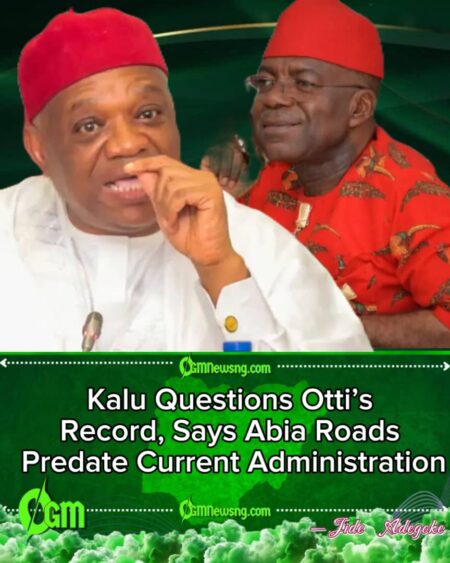
Former Abia State Governor and Senator representing Abia North, Orji Uzor Kalu, has criticised the performance of the current Abia State Governor, Alex Otti, claiming that the present administration has not delivered any major new infrastructure projects. According to Kalu, the roads being showcased by the Otti-led government were constructed during his tenure and are now merely being repainted.
Kalu’s remarks have reignited political debate in Abia State, drawing attention to questions of governance, continuity, and how public projects are assessed and attributed across successive administrations.
Kalu’s Claim on Infrastructure Development
Speaking on the state of development in Abia, Senator Kalu said he had not seen any landmark project that could be directly credited to Governor Otti since he assumed office. He argued that most of the visible road projects being promoted by the current government were originally built during his time as governor and are now undergoing cosmetic upgrades.
The former governor maintained that repainting road markings and carrying out surface-level rehabilitation should not be presented as fresh infrastructure development. He stressed that governance should be judged by the execution of new projects that have a lasting impact on the lives of citizens.
Kalu’s comments suggest a broader concern about how achievements are communicated to the public, warning against what he described as the rebranding of existing assets as new accomplishments.
Political Reactions and Public Debate
The statement has generated mixed reactions among political observers and residents of Abia State. Supporters of Senator Kalu argue that his administration invested heavily in road construction and that historical records should be respected. They believe continuity in governance should involve acknowledgment of previous efforts rather than their reclassification.
On the other hand, allies of Governor Otti contend that maintenance, rehabilitation, and improvements to existing infrastructure are legitimate aspects of governance. They argue that ensuring roads remain functional and safe is as important as building new ones, especially in a state with long-standing infrastructure challenges.
The exchange has further highlighted the growing political rivalry in Abia, as public discourse increasingly focuses on performance records ahead of future electoral cycles.
Infrastructure, Legacy, and Governance Standards
Beyond individual claims, the debate raises broader questions about how governance success is measured in Nigeria. Analysts note that while new projects are important, maintenance of existing infrastructure has historically been neglected, often leading to rapid deterioration of public assets.
Experts also point out that disputes over legacy are common in Nigerian politics, particularly when administrations change hands across party lines. They argue that transparent documentation of projects, timelines, and funding can help reduce controversies over ownership and performance.
As Abia State residents assess the claims and counterclaims, attention remains on tangible outcomes and how government actions translate into improved living conditions for the population.
Table of Contents
Discover more from OGM News NG
Subscribe to get the latest posts sent to your email.