






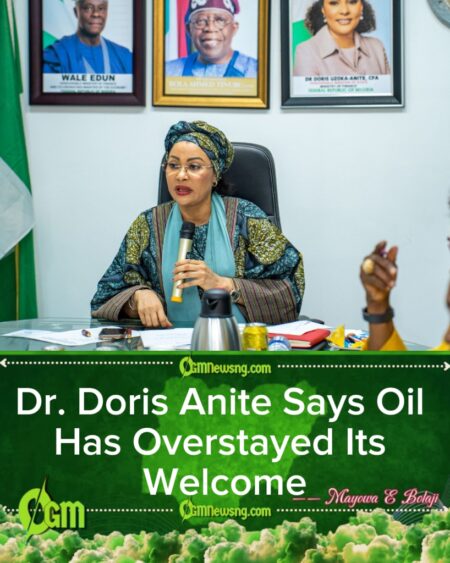
The Minister of State, Dr. Doris Anite, has stressed that domestic resource mobilisation remains central to Nigeria’s long-term fiscal sustainability, as the country seeks to reduce its dependence on volatile oil revenues.
Speaking within the framework of President Bola Tinubu’s Renewed Hope Agenda, the minister said Nigeria must urgently strengthen non-oil revenue streams to diversify income sources and build economic resilience.
Dr. Anite noted that while oil has historically played a dominant role in funding government activities, global market uncertainties and declining production have exposed the risks of overreliance on crude exports. According to her, sustainable public finance can only be achieved by improving internal revenue generation, enhancing efficiency in tax administration, and broadening the revenue base across key sectors of the economy.
Her remarks have once again brought fiscal reform to the forefront of national discourse, as policymakers, economists, and investors closely watch how the Tinubu administration plans to stabilize public finances.
The emphasis on domestic resource mobilisation aligns with ongoing reforms aimed at boosting confidence in Nigeria’s economic management and ensuring predictable funding for development priorities.
Domestic Resource Mobilisation and the Push for Fiscal Sustainability
Dr. Doris Anite explained that domestic resource mobilisation is not merely a policy option but a necessity for fiscal sustainability in Nigeria. She pointed out that rising public expenditure, infrastructure demands, and social obligations require a reliable and internally generated revenue framework that can withstand external shocks.
According to the minister, strengthening domestic revenue involves improving tax compliance, expanding the tax net, and reducing leakages within government revenue systems. She emphasized that a transparent and efficient revenue structure would help government plan better, reduce excessive borrowing, and ensure that public funds are directed toward critical sectors such as education, healthcare, and infrastructure.
Economic analysts say this focus could help Nigeria gradually address persistent budget deficits and debt servicing pressures. By mobilizing resources locally, the government can reduce exposure to foreign exchange risks and global commodity price fluctuations, which have historically disrupted fiscal planning and economic stability.
Non-Oil Revenue as a Pillar of the Renewed Hope Agenda
Under President Tinubu’s Renewed Hope Agenda, Dr. Anite said non-oil revenue growth is a major pillar of economic diversification. She highlighted sectors such as manufacturing, agriculture, telecommunications, the digital economy, and services as critical drivers of sustainable income generation beyond crude oil.
The minister noted that policies supporting business growth, innovation, and private sector participation are essential to unlocking these non-oil revenue opportunities. By creating an enabling environment for enterprises to thrive, the government expects to expand taxable economic activities and generate steady revenue without overburdening citizens.
She added that strengthening non-oil revenues would also help Nigeria build economic resilience, ensuring that government finances remain stable even when oil prices fall or production levels decline. This approach, she said, is fundamental to achieving inclusive growth and long-term national development.
Economic Resilience, Policy Expectations, and the Road Ahead
Dr. Doris Anite maintained that fiscal sustainability is closely linked to economic resilience, stressing that Nigeria must be prepared to absorb shocks arising from global economic disruptions. Domestic resource mobilisation, she said, provides the foundation for such resilience by giving government greater control over its financial planning.
Stakeholders expect that the Renewed Hope Agenda will translate these policy commitments into concrete actions, including stronger institutions, improved revenue governance, and accountability in public finance management.
Analysts argue that consistent implementation will be crucial to restoring investor confidence and public trust in fiscal reforms.
As Nigeria navigates ongoing economic challenges, Dr. Anite’s remarks underscore the administration’s determination to move away from oil dependency toward a more diversified and sustainable fiscal model. If effectively implemented, the strategy could mark a significant shift in Nigeria’s economic trajectory and strengthen its capacity to fund development priorities in the years ahead.
Table of Contents
Discover more from OGM News NG
Subscribe to get the latest posts sent to your email.