






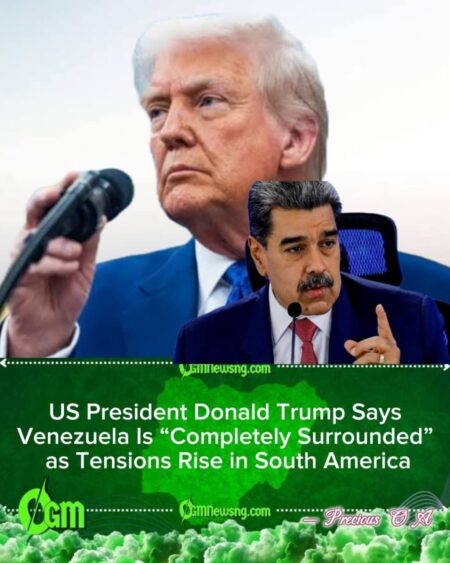
US President Donald Trump said Venezuela is now “completely surrounded by the largest Armada ever assembled in the history of South America,” a claim that immediately drew international attention and raised questions about the scope and intent of U.S. pressure on Caracas. His remarks framed the situation as a decisive show of strength aimed at compelling political change while underscoring Washington’s view of Venezuela as a destabilizing force in the region. The language was sweeping and dramatic, signaling to both domestic and international audiences that the administration views the moment as a critical turning point in its Venezuela strategy.
Donald Trump emphasized that the posture was designed to deter further aggression and illicit activity, presenting the deployment as a defensive measure rather than a prelude to conflict. He stressed that the United States seeks to prevent threats tied to narcotics trafficking, organized crime, and regional instability, all of which he argued emanate from Venezuela’s current leadership. By framing the action as preventative, Trump attempted to reassure allies and critics that force was not the objective, but leverage.
Donald Trump’s comments arrived amid heightened diplomatic signaling, with allies and rivals alike parsing the language for indications of escalation. While no operational details were provided publicly, the rhetoric suggested a coordinated presence meant to send a clear message of resolve. Observers noted that such statements often serve multiple purposes at once, blending deterrence, negotiation pressure, and political messaging into a single narrative.
Military Posture and Strategic Messaging
Donald Trump portrayed the situation as unprecedented in scale, asserting that the assembled forces represented a historic concentration of naval power in South American waters. He framed the posture as a signal that the United States would not tolerate threats to international shipping lanes or regional stability. The emphasis on scale was intended to convey seriousness, projecting strength without explicitly committing to specific military actions.
Donald Trump insisted that the show of force was calibrated and deliberate, intended to pressure leadership without harming civilians. He reiterated that any actions would be consistent with international law and conducted alongside partners who share similar security concerns. Administration officials echoed this message, emphasizing rules of engagement and restraint as essential components of the strategy.
Donald Trump’s allies echoed the emphasis on deterrence, noting that strategic visibility can sometimes prevent miscalculation. Critics, however, cautioned that heightened rhetoric risks misunderstanding and escalation if not paired with clear diplomatic off-ramps. Analysts pointed out that history offers examples where signaling worked, but also cases where it backfired, underscoring the stakes involved.
Regional Reactions and Diplomatic Fallout
Donald Trump’s statement prompted swift reactions across Latin America, with several governments urging restraint and transparency. Regional leaders called for dialogue and stressed the importance of avoiding actions that could inflame tensions or disrupt trade. Many emphasized the interconnected nature of regional economies and the need for stability.
Donald Trump acknowledged these concerns while maintaining that pressure was necessary to alter behavior he described as unlawful and destabilizing. He argued that prior diplomatic efforts had failed to produce meaningful change, leaving limited options. From his perspective, decisive action was framed as a response to prolonged inaction.
Donald Trump’s posture placed neighboring countries in a delicate position, balancing alliances with the United States against domestic concerns about sovereignty and spillover effects from any prolonged standoff. Governments weighed public opinion at home while managing diplomatic relationships abroad, highlighting the complexity of the regional response.
Economic Pressure and Sanctions Context
Donald Trump linked the military rhetoric to broader economic measures, pointing to sanctions as a parallel tool meant to constrain revenue streams. He argued that financial pressure, combined with visible deterrence, could accelerate negotiations and force accountability. The administration framed sanctions as leverage rather than punishment.
Donald Trump maintained that sanctions were targeted and reversible, contingent on verifiable steps toward reform. Supporters said this dual-track approach offered leverage without immediate conflict, allowing diplomacy to remain viable. Officials emphasized that relief could follow compliance.
Donald Trump’s critics countered that economic restrictions have humanitarian consequences and urged expanded exemptions and aid channels to mitigate harm to ordinary Venezuelans. They argued that any strategy must balance pressure with compassion to avoid exacerbating suffering among civilians.
International Law and Rules-Based Order
Donald Trump framed the situation as a defense of the rules-based order, asserting that the United States was acting to uphold maritime security and counter transnational crime. He emphasized cooperation with partners to ensure legitimacy and shared responsibility. The rhetoric sought to situate U.S. actions within a broader international framework.
Donald Trump underscored that any operations would respect international norms, seeking to preempt accusations of unilateralism. Officials highlighted consultations with regional organizations as evidence of coordination and transparency. This emphasis was designed to reinforce credibility.
Donald Trump’s remarks nonetheless revived debates about proportionality and precedent, with analysts stressing the need for clarity to avoid misinterpretation by adversaries. They noted that ambiguity can deter, but it can also confuse, increasing the risk of unintended consequences.
Pathways Forward and De-escalation
Donald Trump said the United States remains open to dialogue if concrete steps are taken, presenting diplomacy as the preferred outcome. He suggested that pressure could be eased if commitments are met and verified, framing engagement as conditional but achievable.
Donald Trump reiterated that the goal is stability, not conflict, and that sustained engagement could yield results. He pointed to past cases where pressure led to negotiations, arguing that firmness and flexibility are not mutually exclusive.
Donald Trump concluded by asserting confidence that resolve, paired with diplomacy, would produce a peaceful resolution, while acknowledging that careful management would be required to prevent escalation. His remarks closed with an emphasis on vigilance, signaling that the situation remains fluid and closely watched.
Table of Contents
Discover more from OGM News NG
Subscribe to get the latest posts sent to your email.