









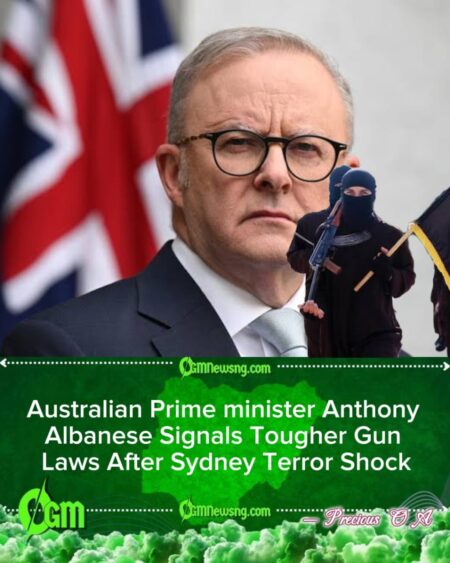
Australian Prime minister Anthony Albanese opened the national conversation by condemning the Sydney ISIS-linked attack as an assault on Australia’s sense of safety, saying the incident demanded sober reflection and decisive action from government at every level. He described the event as deeply unsettling for ordinary Australians who expect public spaces to be secure, emphasizing that the psychological impact of terrorism often extends far beyond the immediate physical harm. His remarks framed the attack as a moment requiring calm leadership rather than panic, while still acknowledging the seriousness of the threat.
Anthony Albanese emphasized that the country’s counterterrorism agencies responded swiftly, crediting intelligence cooperation and frontline policing while acknowledging that prevention must evolve alongside emerging threats. He highlighted the role of federal and state coordination, noting that rapid information sharing and operational readiness helped prevent further escalation. At the same time, he cautioned that successful responses after the fact are not enough, arguing that policy must continually adapt to shifting tactics used by extremist groups.
The Prime Minister’s remarks set a serious tone, framing the attack not as an isolated episode but as a warning that extremist violence continues to adapt, requiring renewed focus on public safety tools and legal frameworks. He stressed that Australia cannot rely solely on past successes, pointing out that evolving global instability and online radicalization create new vulnerabilities. This framing positioned the government’s response as forward-looking rather than reactive.
Call for Tougher Gun Laws
Anthony Albanese proposed a review of existing firearms regulations, arguing that Australia’s historic success with gun reform should not breed complacency in the face of new risks. He reminded Australians that earlier reforms dramatically reduced gun violence, but insisted that laws must be regularly reassessed to remain effective. According to him, the goal is not to rewrite the system wholesale but to ensure it remains fit for purpose in a changing security environment.
Anthony Albanese said the government would consult states and territories on tightening loopholes, improving licensing standards, and enhancing enforcement mechanisms tied to illegal weapons trafficking. He noted that cooperation across jurisdictions is essential, given that firearms regulations vary and criminal networks exploit inconsistencies. These consultations, he explained, would focus on evidence and expert advice rather than political posturing.
The proposal drew immediate attention because Australia’s gun laws are already among the strictest globally, raising questions about what additional measures could realistically be introduced. Commentators began speculating about expanded background checks, tougher penalties for illegal possession, and increased monitoring of firearm storage. The discussion quickly moved beyond policy specifics to a broader debate about security, trust, and national identity.
Balancing Freedom and Safety
Anthony Albanese acknowledged concerns from civil liberties groups, stressing that any changes would be proportionate, evidence-based, and respectful of lawful gun ownership for sport and rural use. He emphasized that farmers, hunters, and sporting shooters should not feel unfairly targeted by reforms aimed at criminal misuse. This reassurance was designed to prevent polarization and maintain public confidence in the process.
Anthony Albanese framed the debate as one about collective security rather than ideology, arguing that Australians historically accept firm rules when the objective is protecting lives. He referenced the country’s track record of pragmatic compromise, suggesting that public safety and individual rights need not be mutually exclusive. His tone sought to lower political temperature while reinforcing the seriousness of the threat.
Opposition figures urged caution, warning that overreach could alienate communities and distract from intelligence-led counterterrorism strategies that target extremist networks directly. Some critics argued that radicalization pathways, not firearm access, should be the primary focus. This tension highlighted the challenge of crafting policy that addresses both immediate risks and deeper causes.
Political and Public Reaction
Anthony Albanese faced mixed reactions in Parliament, with some lawmakers praising decisive leadership while others questioned whether gun laws address the root causes of radicalization. Supporters argued that visible action reassures the public and demonstrates resolve, while skeptics warned against symbolic measures. The exchanges reflected broader ideological divides about security policy.
Anthony Albanese responded by noting that policy responses need not be singular, saying gun regulation, border security, online monitoring, and community engagement can work together. He rejected the idea of choosing one approach over another, instead advocating for a layered strategy that tackles threats from multiple angles. This holistic framing aimed to counter claims that the government was oversimplifying the issue.
Public sentiment reflected similar divisions, as polling and talkback radio revealed support for safety-focused reforms alongside skepticism about their practical impact. Some Australians expressed confidence in tougher laws, while others questioned whether they would deter determined attackers. The debate underscored the complexity of governing in a climate of fear and uncertainty.
Counterterrorism Strategy Moving Forward
Anthony Albanese linked the gun law discussion to a broader counterterrorism reset, highlighting investments in intelligence sharing, cyber surveillance, and deradicalization programs. He stressed that prevention begins long before an attack occurs, often in online spaces where extremist narratives take root. These investments, he said, are designed to disrupt threats early.
Anthony Albanese stressed cooperation with international partners, pointing out that extremist threats often cross borders digitally even when attacks are carried out locally. He referenced alliances with regional and global intelligence agencies, emphasizing that no country can confront modern terrorism alone. This international dimension reinforced the seriousness of the challenge.
Security analysts noted that Australia’s layered approach—combining prevention, enforcement, and rehabilitation—will likely shape how any new gun measures are implemented. Experts suggested that success depends on integration rather than isolated policy changes. Their assessments added nuance to the public debate.
National Unity and the Road Ahead
Anthony Albanese closed his remarks by urging national unity, saying moments of crisis test democratic resolve and the capacity to respond without fear-driven policymaking. He appealed to Australians to resist division and misinformation, emphasizing shared values of resilience and fairness. This call aimed to steady public discourse.
Anthony Albanese reiterated that the government’s priority is protecting Australians while preserving the values that define the country’s open society. He stressed that security measures must strengthen, not weaken, democratic norms. This balance, he argued, is essential for long-term stability.
As consultations begin, the debate over tougher gun laws is expected to intensify, positioning security, rights, and responsibility at the center of Australia’s political conversation. The coming months will likely see detailed proposals, public submissions, and heated discussion. Ultimately, the outcome will shape how Australia responds to evolving threats while remaining true to its principles.
Table of Contents
Discover more from OGM News NG
Subscribe to get the latest posts sent to your email.