







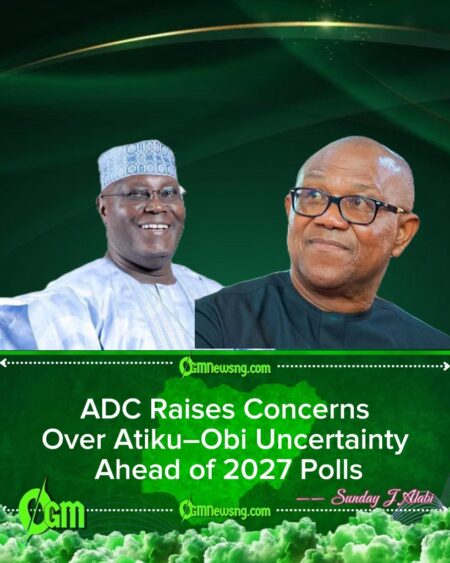
As Nigeria gradually moves toward the 2027 general election, the African Democratic Congress (ADC) has expressed concern over the uncertainty surrounding potential cooperation between former Vice President Atiku Abubakar and former Labour Party presidential candidate Peter Obi. The party acknowledged that the absence of a united front between the two prominent opposition figures could pose a strategic challenge, even as it cautioned against framing the situation as an existential threat to Nigeria’s democracy.
The concerns were raised by Mallam Bolaji Abdullahi, spokesperson of the ADC, during a televised interview on Arise TV’s The Morning Show. Abdullahi noted that while the dynamics between Atiku and Obi are significant, the ADC remains focused on internal consolidation and long-term preparation ahead of the 2027 polls.
ADC’s Position on the Atiku–Obi Dynamic
Abdullahi confirmed that the ADC is worried about the possibility that Atiku and Obi may not work together in 2027, describing the situation as a “conundrum” and a “challenge” for opposition politics. However, he was careful to downplay suggestions that the issue represents the greatest danger to Nigeria’s democratic system.
According to him, the party does not view the matter in extreme terms, even though it recognises its importance. He explained that the ADC is conscious of the broader political implications but is deliberately avoiding alarmist interpretations that could distract from its organisational goals.
He further stressed that the ADC is not currently engaged in discussions about specific presidential candidates, insisting that such conversations are premature at this stage of the political cycle.
Focus on Party Building and Nationwide Presence
Abdullahi said the ADC’s immediate priority is to strengthen its national structures and ensure it has a functional presence across all 36 states and the Federal Capital Territory. He explained that building grassroots capacity and organisational strength has taken precedence over debates about personalities and presidential ambitions.
The spokesperson noted that the task of establishing a credible nationwide platform has preoccupied the party leadership, given the scale of preparation required to compete effectively in a general election. According to him, these foundational efforts are essential before the party can meaningfully address questions of ticket zoning or candidate selection.
While acknowledging that the Atiku–Obi issue will eventually have to be addressed, Abdullahi maintained that the ADC believes it must first position itself as a serious national contender before engaging in high-level negotiations over presidential tickets.
Candidate Selection, Consensus, and Coalition Talks
On how the ADC plans to manage its presidential nomination process, Abdullahi disclosed that the party may explore consensus as a first option. He explained that consensus remains an accepted mechanism within the party, but stressed that it would not be imposed if it proves unworkable.
If consensus fails, he said the party would open its presidential ticket to all qualified aspirants, noting that interest in the race extends beyond Atiku Abubakar and Peter Obi. Abdullahi emphasised that the 2027 contest is not a settled two-horse race and that the ADC is prepared to accommodate a broader field of aspirants.
He also revealed that the ADC is engaged in ongoing discussions with other political parties, aimed at forming a stronger coalition ahead of the 2027 election. According to him, such alliances could reshape the political landscape and enhance the opposition’s competitiveness in the coming polls.
Table of Contents
Discover more from OGM News NG
Subscribe to get the latest posts sent to your email.