




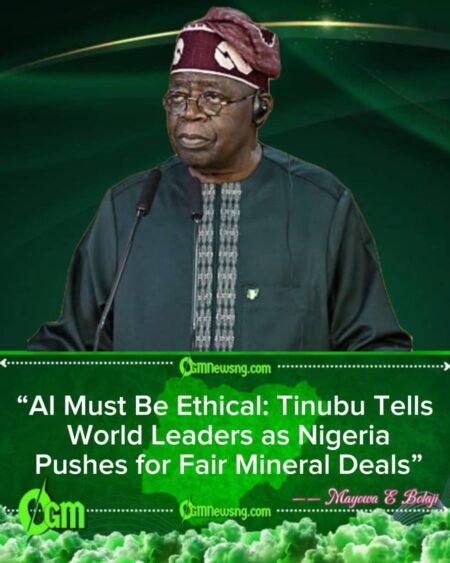
President Bola Tinubu began his forceful intervention at the G20 Leaders’ Summit by declaring that the era of Africa serving as a mere extraction zone for the world’s industrial powers was over, stressing that host communities in Nigeria and across the continent must finally receive direct, measurable, and equitable benefits from the exploitation of their mineral wealth. He argued that nations dependent on African critical minerals for clean energy and technological expansion must confront the legacy of resource injustice that has impoverished producing regions while enriching multinational corporations and foreign economies.
President Bola Tinubu further intensified the debate by accusing major mineral-importing countries of pursuing development models that rely on Africa’s raw materials without contributing to sustainable local growth, insisting that such an imbalance can no longer be defended in the modern global economy. He demanded a transformative global agreement that sets binding terms for fair compensation, community development, and environmental protection as prerequisites for future mineral partnerships.
President Bola Tinubu doubled down on his position by urging world leaders to acknowledge that Africa has the sovereign right to renegotiate its place in the global value chain, arguing that African nations are ready to shift from raw material suppliers to full participants in mineral processing, manufacturing, and strategic decision-making. He warned that without structural changes, the global economic order will remain fundamentally exploitative.
President Bola Tinubu Warns Global Powers Against Continued Exploitation of African Resources
President Bola Tinubu condemned what he described as a historical pattern of resource plunder, telling global leaders that Africa’s mineral wealth should no longer be treated as an open buffet for industrial nations pursuing green transitions, energy independence, and technological supremacy. He argued that the transformation of Africa’s mineral sector must be founded on justice, accountability, and mutually beneficial cooperation, not the paternalistic arrangements of the past.
President Bola Tinubu sharply criticized multinational corporations that, in his view, have long benefited from weak regulatory systems and opaque mining contracts, leaving African communities devastated by pollution, displacement, and poverty. He challenged global partners to embrace transparency and commit to fair taxation, local processing, and the inclusion of African governments in value-chain governance.
President Bola Tinubu asserted that Africa will no longer accept economic models that perpetuate underdevelopment while foreign investors reap the rewards, declaring that any nation unwilling to adopt ethical and balanced resource agreements should not expect privileged access to Nigeria’s or Africa’s critical minerals. His remarks sparked discomfort among some delegations, signaling a new era of assertiveness in Africa’s global diplomacy.
President Bola Tinubu Calls for Global Ethical Standards for Artificial Intelligence
President Bola Tinubu broadened his address by warning that the digital future must not replicate the injustices of the mineral economy, calling for global ethical standards to govern Artificial Intelligence. He argued that without strict oversight, AI could deepen inequality, undermine national sovereignty, and exclude developing nations from the technological systems that will dominate the 21st century.
President Bola Tinubu stressed that AI must be developed and deployed with fairness, transparency, and global cooperation at its core, urging technology-producing nations to avoid constructing digital monopolies that marginalize Africa’s emerging innovators. He insisted that ethical AI is inseparable from Africa’s demand for economic equity, since both are ultimately about justice, inclusion, and shared progress.
President Bola Tinubu concluded by asserting that Nigeria remains committed to building a future where mineral wealth powers industrialization, and where responsible AI strengthens human development rather than erasing human agency. His intervention placed Nigeria at the center of global conversations on resource justice and ethical technology, provoking debate across diplomatic circles.
Table of Contents
Discover more from OGM News NG
Subscribe to get the latest posts sent to your email.