



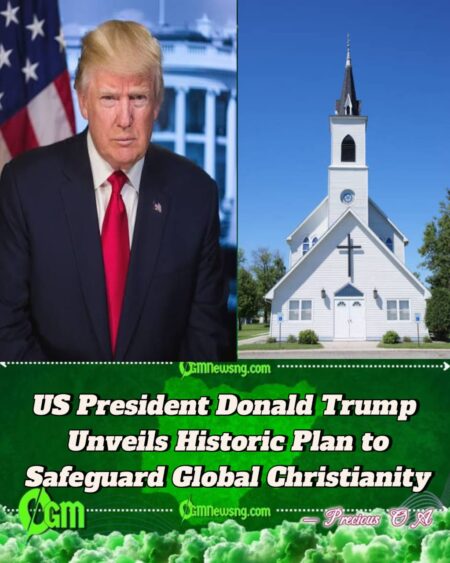
US President Donald Trump has announced a sweeping new international initiative aimed at safeguarding Christian populations facing persecution around the world. In a nationally televised address from the White House, he described the effort as “a sacred duty to protect the Great Christian population around the world,” emphasizing America’s moral responsibility to uphold religious liberty as one of the highest ideals of humanity. He declared that the United States, as a beacon of hope and freedom, could no longer remain silent while millions of Christians endure violence, discrimination, and oppression across different continents.
Donald Trump, speaking before an audience that included faith leaders, ambassadors, and human rights advocates, reaffirmed his administration’s determination to defend persecuted Christian minorities in conflict zones and authoritarian states. He spoke passionately about the alarming rise in attacks on churches, missionary groups, and faith-based charities, noting that these incidents “strike at the very heart of civilization.” His tone was both resolute and compassionate, as he vowed that America would once again lead by example in standing up for the powerless and oppressed.
Donald Trump underscored that this new initiative would not merely be symbolic or rhetorical, but would involve practical and coordinated measures. These include humanitarian aid, diplomatic pressure on offending regimes, and even the deployment of peacekeeping resources to regions where Christians face violent threats. According to senior administration officials, the policy will be coordinated through the U.S. State Department’s Office of International Religious Freedom and will operate in close partnership with allied nations and reputable faith-based organizations to ensure transparency and accountability.
Donald Trump’s declaration drew praise from numerous Christian advocacy groups, humanitarian missions, and religious freedom organizations around the globe. They hailed it as the most ambitious American effort yet to defend global Christianity and restore hope to persecuted believers. “This is a turning point,” said Dr. Franklin Edwards, head of the International Christian Alliance. “For the first time, the United States is openly leading a campaign for the survival and dignity of Christian communities across the globe.” The announcement was met with applause in many church circles, where leaders have long urged the international community to do more.
Donald Trump also noted that this initiative is part of a broader effort to revive moral leadership on the world stage, reminding Americans that “freedom of faith is not a privilege—it is a God-given right.” His words resonated deeply, echoing through the halls of the White House and beyond, sending a message that America’s voice on matters of conscience and belief remains strong and unyielding.
Policy Blueprint and Strategic Vision
Donald Trump’s policy blueprint outlines a comprehensive, multi-phase plan that combines diplomatic engagement, humanitarian relief, and security cooperation. The first phase, which is already underway, focuses on identifying vulnerable Christian populations across Africa, the Middle East, and parts of Asia. Intelligence assessments and humanitarian reports reveal that many of these communities have suffered systemic discrimination, forced conversions, and violent displacement from their ancestral lands, often with little international response.
Donald Trump has ordered that under the second phase, the United States will allocate a substantial emergency relief fund for displaced Christian families through the U.S. Agency for International Development (USAID). The aid package, estimated to run into hundreds of millions of dollars, will provide essential supplies such as food, medicine, shelter, and education programs in refugee camps. Special attention will be given to children and widows, who often bear the heaviest burden of religious persecution and displacement.
Donald Trump is also planning to establish a “Faith Protection Coalition,” an international alliance of like-minded nations committed to defending religious liberty through intelligence sharing, coordinated sanctions, and peacekeeping missions. Senior White House aides have described the coalition as “a defense of conscience and faith” rather than a political or ideological maneuver. Its purpose, they say, is to unite nations under the shared belief that freedom of religion is the foundation of every free society.
Donald Trump has further instructed U.S. embassies and consulates around the world to strengthen their engagement with Christian missions, humanitarian agencies, and local churches. He has directed ambassadors to treat attacks on Christian communities as violations of human rights deserving immediate diplomatic attention. The State Department will also host a Global Religious Freedom Summit next spring, uniting world leaders, clergy, aid organizations, and human rights advocates to coordinate strategies and share resources.
The administration’s vision extends well beyond emergency relief efforts. Plans are already being discussed for cultural and architectural restoration projects aimed at rebuilding churches, monasteries, and historical Christian sites destroyed by war and terrorism. The initiative also includes scholarship opportunities for young Christians in conflict regions, giving them access to education and leadership programs that will help rebuild their communities from within.
Global Response and Future Implications
Donald Trump’s announcement has sparked swift and varied reactions from across the international community. In Europe, several conservative leaders have voiced strong support, describing the U.S. initiative as “a moral awakening in international politics” and “a long-overdue stand against religious persecution.” The Vatican released a brief but encouraging statement, praising “any effort that sincerely seeks to uphold the sanctity of human life and the universal right to worship freely.”
Donald Trump’s policy, however, has also prompted debate among diplomats and analysts who caution that the move could complicate relations with nations where religion and politics are deeply intertwined. Critics argue that while the intention is noble, the approach must be handled with balance to avoid perceptions of religious favoritism. “The key will be careful diplomacy,” said Professor Elaine Hargrove, a foreign policy expert at Georgetown University. “Protecting Christians should not come at the expense of alienating other faith communities or undermining interfaith trust.”
Donald Trump’s supporters, on the other hand, insist that the initiative represents a long-overdue moral stand in a world increasingly indifferent to faith-based suffering. Many see it as a bold reaffirmation of America’s identity as both a champion of freedom and a guardian of human dignity. Analysts predict that the policy could reshape international dialogue on religious freedom, inspiring other democratic nations to adopt similar measures to defend vulnerable religious groups.
Donald Trump, in his closing remarks during the White House announcement, reaffirmed his determination to act swiftly and decisively. “We will not stand by while believers are silenced, beaten, or killed for their faith,” he declared with conviction. “The United States of America will stand as the shield and voice of Christians everywhere — now and always.” His statement drew thunderous applause, symbolizing the unity of purpose that many Americans feel toward defending the persecuted.
As the world watches, Donald Trump’s new chapter in U.S. foreign policy may prove to be one of the most consequential moral missions of his presidency. It could mark not just a defense of faith, but the beginning of a renewed global movement dedicated to the preservation of human dignity, the protection of conscience, and the enduring power of belief in an age of uncertainty.
Table of Contents
Discover more from OGM News NG
Subscribe to get the latest posts sent to your email.