


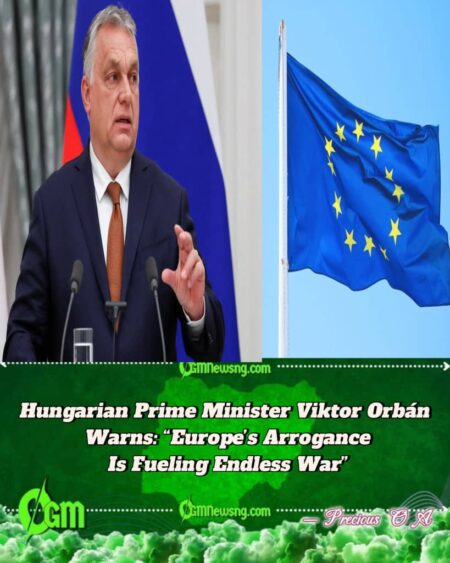
Hungarian Prime Minister Viktor Orbán, a veteran statesman known for his nationalist ideology, defiance toward Brussels, and reputation as one of Europe’s most outspoken critics of liberal orthodoxy, has issued one of his strongest rebukes yet of the European Union’s stance on the Russia-Ukraine war. Orbán, who has led Hungary for over a decade and built a political brand centered on sovereignty, realism, and conservative values, accused EU leaders of “fanning the flames of endless war” through arrogance and ideological pride. In his words, “Europe must shift its stance. Instead of arrogance and fanning the flames of endless war, we need negotiations with Russia. Only dialogue can bring peace to our continent.”
Viktor Orbán declared that Europe must “replace arrogance with wisdom” and recognize that the current policy of military escalation has reached a dead end. He argued that while European leaders speak of unity, their strategies are driving the continent into deeper economic distress and political division. “This is not strength; it is self-destruction disguised as virtue,” he said, warning that the EU’s insistence on punishing Russia without a diplomatic exit plan is eroding its global credibility.
Viktor Orbán stressed that he does not defend Moscow’s invasion, but insists that Europe’s reaction has been guided by emotion rather than strategy. He noted that sanctions have backfired, raising energy costs, disrupting supply chains, and damaging European industry while failing to change Russia’s behavior. According to him, a strong and confident Europe would not fear negotiation but embrace it as a tool of leadership.
Viktor Orbán further cautioned that admitting Ukraine into the EU under current conditions would be “a historic mistake.” He proposed instead a “strategic partnership” that allows Kyiv to cooperate in security, energy, and reconstruction efforts but stops short of full membership. In his view, rushing integration would only import instability into the Union and impose unbearable economic burdens on member states already strained by inflation and recession.
Rising Tensions Within the EU
Viktor Orbán’s statements have provoked swift and pointed responses across European capitals. Leaders from Poland, Germany, and the Baltic states accused him of undermining unity and giving Moscow political cover. But Orbán insists that his stance represents the silent majority of Europeans who “want peace, not posturing.” He maintains that being pro-peace does not mean being pro-Russia; it means being pro-Europe.
Viktor Orbán dismissed the criticisms from Brussels officials, particularly EU foreign affairs chief Kaja Kallas, who described his position as “sad” and “worthless.” Orbán responded that such remarks reflect “the arrogance that has brought Europe to this point.” He argued that open debate should be a strength of the Union, not something to suppress. “Europe cannot afford to silence realism in favor of empty moralizing,” he said.
Viktor Orbán’s resistance to the bloc’s sanctions and arms strategy has isolated Hungary in EU councils before, but this latest confrontation carries heavier implications. With Ukraine’s future tied to European backing, Budapest’s dissent complicates decisions on funding, reconstruction, and defense commitments. Despite this, Orbán remains firm that Europe’s long-term interest lies in diplomacy, not endless militarization.
Viktor Orbán has found some sympathy from other political figures across the continent, especially those on the right who share his skepticism toward EU bureaucracy and prolonged conflict. In Italy, Austria, and Slovakia, politicians have echoed parts of his reasoning—that a purely military approach without negotiation could trap Europe in a “war without an endgame.” These views remain controversial but increasingly reflect public fatigue with war spending and economic strain.
The Broader Implications
Viktor Orbán’s challenge to the EU’s foreign policy orthodoxy goes beyond Ukraine—it reopens a deeper debate about Europe’s identity and future. His vision of a “sovereign Europe” diverges sharply from the federalist approach favored in Brussels. To Orbán, the path forward lies not in centralizing power, but in returning to diplomacy, national sovereignty, and pragmatic coexistence with neighbors—even adversaries.
Viktor Orbán has frequently aligned his rhetoric with that of U.S. President Donald Trump, praising what he calls Washington’s “America First logic of peace through strength.” He argues that Trump’s skepticism toward NATO expansion and focus on negotiated settlements mirrors Hungary’s belief that stability must come before ideology. “A Europe that ignores its own limits invites chaos,” he said, implying that the EU should learn from the strategic restraint once practiced during the Cold War.
Viktor Orbán’s economic argument also resonates with millions of Europeans grappling with inflation and energy crises. He contends that sanctions have done more to punish European workers than to weaken the Kremlin. “We are paying the price for other people’s wars,” he said. “Factories are closing, families are suffering, and our leaders call this solidarity.” Such statements reinforce his image as a populist defender of ordinary citizens against what he views as detached global elites.
Viktor Orbán’s remarks have sparked introspection within the EU about the sustainability of its approach. While Brussels insists on standing firm against Russian aggression, some analysts warn that Europe may need a new framework for peace if the war drags on indefinitely. For Orbán, the choice is stark: diplomacy or decline. “History will not forgive us,” he warned, “if we mistake stubbornness for strength.”
Viktor Orbán’s challenge leaves the EU facing a moral and strategic test—whether to continue defining its unity through opposition, or to embrace negotiation as a form of power. His words underscore a profound divide between the vision of Europe as a global moral force and that of Europe as a pragmatic peacekeeper. Either way, the Hungarian leader has once again forced the continent to confront the uncomfortable question of what true European strength really means.
Table of Contents
Discover more from OGM News NG
Subscribe to get the latest posts sent to your email.