









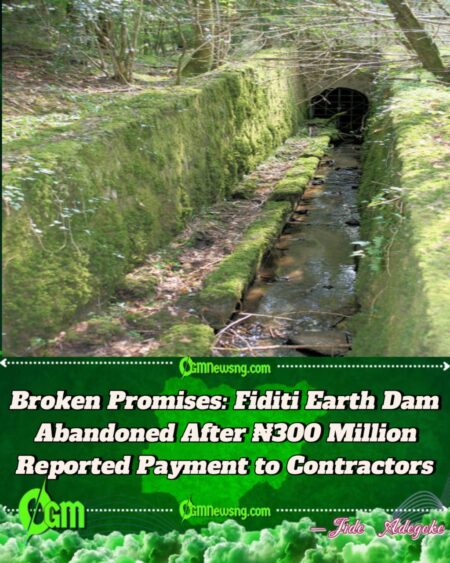
The Fiditi Earth Dam project in Oyo State has reportedly been abandoned despite claims by a Nigerian lawmaker that over ₦300 million had already been paid to contractors for its completion. The project, originally conceived to boost water supply, irrigation, and local agriculture, now lies in a state of neglect, overgrown with weeds and surrounded by rusting equipment.
The lawmaker’s claim of ₦300 million payments has drawn sharp criticism from residents and civil society groups, who insist that the site shows no visible signs of work commensurate with such a large financial disbursement. Local communities depending on the dam for irrigation have expressed frustration, saying the abandonment of the project has worsened water scarcity, stifled farming productivity, and eroded public trust in government infrastructure commitments.
The Fiditi Earth Dam, which was expected to serve as a vital resource for agricultural and domestic water needs, now symbolizes the challenges of accountability and transparency in Nigeria’s public works sector. Experts say the project’s abandonment reflects a broader national issue of poor project supervision and the frequent diversion of public funds.
Lawmaker’s Claim of ₦300 Million Payments Raises Accountability Questions
The lawmaker’s claim of ₦300 million payments has ignited fresh demands for an investigation into how public funds were utilized in the Fiditi Earth Dam project. Reports indicate that while financial allocations were approved and contractors allegedly paid, the on-ground reality contradicts official narratives of progress.
The lawmaker’s claim of ₦300 million payments also highlights inconsistencies in project reporting and monitoring mechanisms within Nigeria’s infrastructure framework. Civil society organizations have urged anti-corruption agencies, including the EFCC and ICPC, to step in and audit the financial records linked to the project. Stakeholders argue that without a transparent review, the situation risks setting a precedent for unaccountable project management in other parts of the country.
The lawmaker’s claim of ₦300 million payments is particularly troubling in the context of growing economic challenges and the federal government’s repeated assurances that funds allocated to constituency projects are being tracked and monitored. The Fiditi case now stands as a test of the government’s willingness to enforce accountability and restore public confidence in development spending.
Fiditi Earth Dam Project Abandonment Reflects Broader Infrastructure Failures
The Fiditi Earth Dam project abandonment has been described by analysts as symptomatic of Nigeria’s recurring pattern of incomplete or failed public projects. Similar cases have been reported across several states, where dams, schools, and healthcare facilities are left unfinished despite significant budgetary allocations.
The lawmaker’s claim of ₦300 million payments underscores the urgent need for reform in the nation’s procurement and project implementation systems. Experts emphasize that the persistence of such scenarios undermines national development goals and denies citizens access to essential services. For communities in Fiditi, the unfulfilled promises have deepened economic hardship and sparked disillusionment with political leaders who fail to deliver on campaign commitments.
The Fiditi Earth Dam, if completed, would have been a crucial boost to the region’s agricultural capacity, helping farmers with irrigation and reducing dependence on rain-fed cultivation. Instead, its abandonment has become a symbol of squandered potential and unfulfilled public trust—a reminder that development without accountability remains an illusion.
Table of Contents
Discover more from OGM News NG
Subscribe to get the latest posts sent to your email.