






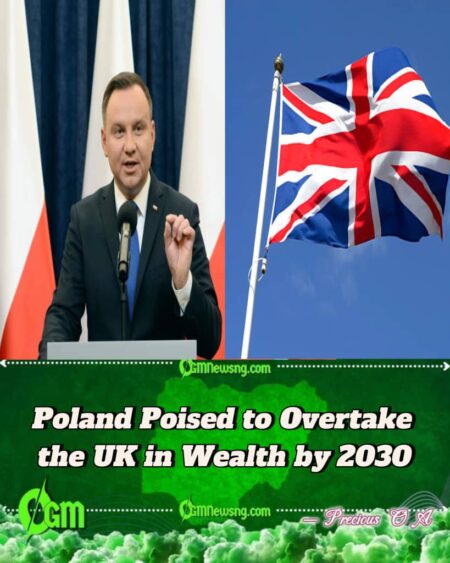
Poland, a Central European nation of over 38 million people, has transformed from a post-communist state into one of Europe’s most dynamic economies. Known for its thriving manufacturing base, strong work ethic, and growing technological sector, the country has emerged as a model of sustained development within the European Union. Once seen as a beneficiary of Western aid, Poland is now positioning itself as a key economic player capable of rivaling older powers like the United Kingdom.
Poland has recorded remarkable economic expansion since 2019, achieving an estimated 19 percent increase in GDP per capita compared with the United Kingdom’s meagre 1 percent rise. The momentum stems from strong investment, growing industrial capacity, and efficient use of European Union development funds. Its manufacturing sector continues to attract foreign investors, while exports of machinery, vehicles, and electronics have strengthened national income.
Poland’s resilience has been particularly notable in its ability to maintain growth through regional and global turbulence. Inflation and supply chain challenges have hurt European economies, but Warsaw’s disciplined fiscal policies and strong consumer demand have kept the economy advancing. Meanwhile, the UK’s economic slowdown, intensified by post-Brexit trade friction and declining productivity, has widened the growth gap.
Poland’s success is not merely a matter of speed but of structure. The country’s workforce remains relatively affordable and highly skilled, encouraging multinational companies to shift production and logistics hubs eastward. Its transport networks and expanding technology sector further enhance competitiveness. The UK, in contrast, continues to rely heavily on services, particularly finance, which have been under pressure since leaving the European Union.
Still, the UK’s nominal GDP per capita remains higher, reflecting higher living costs and a more developed service economy. For Poland to sustain its catch-up, economists stress the need for continued innovation, investment in education, and demographic resilience. Without those elements, its rapid convergence could slow before it overtakes Britain fully.
Poland’s forward-looking economic policies have also played a key role in maintaining its momentum. The government has prioritized domestic production, improved vocational education, and invested heavily in research and development. Public-private partnerships have boosted entrepreneurship, helping small and medium-sized enterprises compete internationally. This approach has built a more balanced economy that can withstand external shocks more effectively than in the past.
Projections, Doubts, and the Road to 2030
Poland’s trajectory has prompted a wave of new projections suggesting it could surpass the UK in GDP per capita by 2030, adjusted for purchasing power parity. International Monetary Fund and European Commission models show Warsaw narrowing the gap at an unprecedented pace, with steady annual growth expected to continue. For many analysts, this represents not a miracle but the result of two decades of disciplined economic reform and integration into European markets.
Skeptics, however, urge caution. Much of Poland’s lead in PPP terms stems from lower living costs, not necessarily higher incomes in real currency. If the UK reignites growth through investment in green energy, digital industries, or manufacturing innovation, the projection could extend well beyond 2030. Even so, Poland’s upward trend has proven resilient enough to make the prospect plausible.
Poland’s policymakers are aware of the delicate balance. Rising wages, demographic decline, and potential labour shortages could hinder growth if not offset by automation and immigration policies. Inflation, while now moderating, remains a risk to household purchasing power and export competitiveness. Maintaining fiscal stability and avoiding overreliance on EU funds will determine whether this economic ascent endures.
If Poland achieves the forecasted milestone, it would be the first Central European nation to surpass a major Western power in modern economic rankings. Economists view it as symbolic of a broader shift: the eastward redistribution of wealth and influence across Europe. The development may redefine perceptions of which economies drive the continent’s future prosperity.
Poland’s financial institutions are also evolving rapidly, with its banking sector modernizing and digital payment systems expanding across the economy. These improvements have increased efficiency and attracted international investors seeking stable, high-yield environments. The growing tech scene in cities such as Warsaw, Kraków, and Wrocław has also given rise to a new generation of entrepreneurs competing on a global scale, further fueling national growth.
Implications, Stakes, and Europe’s New Economic Order
Poland overtaking Britain would represent more than a statistical crossover—it would mark a political and psychological transformation in European affairs. Such a development would confirm that the economic balance forged after the fall of communism has reached maturity. Warsaw’s growing influence could shift debates within the EU over fiscal policy, defence, and industrial strategy.
Poland’s economic leadership may inspire other Central and Eastern European nations seeking to replicate its model of rapid modernization. Structural reforms, strong public investment, and integration with Western markets have all contributed to this success. If replicated region-wide, the European Union could experience a re-centering of economic power closer to its eastern frontier.
The UK, meanwhile, would face renewed scrutiny over its growth strategy and its ability to remain competitive post-Brexit. Analysts warn that falling behind Poland in wealth per capita would carry deep reputational implications, raising questions about innovation, productivity, and governance. The comparison could become a rallying point for political debate on economic reform and trade policy.
Poland’s advance, if sustained, will test the resilience of both economies. The UK’s established financial and technological strengths remain considerable, while Poland’s challenge lies in ensuring inclusive and sustainable prosperity. The outcome will define Europe’s new hierarchy of growth—and underscore how profoundly the continent’s economic map is changing.
For many observers, the race between Poland and the UK is more than a contest of numbers; it is a reflection of shifting global realities. As Central and Eastern Europe continue to modernize, traditional powers face renewed competition from nations once considered economic underdogs. In this unfolding story, Poland’s rise is not an exception but a sign of the times—one that could redefine Europe’s economic destiny.
Table of Contents
Discover more from OGM News NG
Subscribe to get the latest posts sent to your email.