









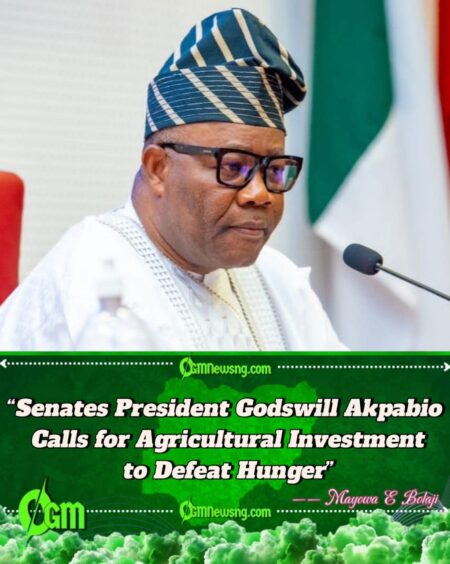
Godswill Akpabio, Nigeria’s Senate President, has sounded a stark warning about the escalating hunger crisis affecting millions across the country. Speaking in Abuja, Akpabio declared, “Hunger cannot be defeated with words. Hunger requires policy direction, diligent budgeting, and willpower to defeat it.” His remarks come amid growing concern from international organizations and local experts, who estimate that over 33 million Nigerians are currently at risk of severe food insecurity.
Godswill Akpabio emphasized that hunger is no longer a distant challenge but an immediate national emergency that touches every corner of the country. According to him, the rising cost of living, coupled with food shortages, has left households struggling to meet basic needs. He noted that millions of Nigerians now spend the bulk of their income on food, leaving little for healthcare, education, or other essentials.
Godswill Akpabio also warned that unchecked hunger poses a serious threat to social stability. When citizens face food insecurity, he argued, frustration often translates into unrest, undermining both local communities and national cohesion. He urged government agencies to recognize that hunger is not just an economic statistic but a lived reality that erodes dignity and hope.
Godswill Akpabio pointed out that the fight against hunger requires prioritizing farmers and agricultural workers. He said that without adequate investment in agriculture, including access to fertilizers, irrigation, and modern technology, Nigeria risks falling into a cycle of dependency on food imports—an unsustainable path for a nation with vast arable land.
Godswill Akpabio’s Call for Policy and Budgetary Action
Godswill Akpabio stressed that hunger cannot be defeated through political promises or rhetoric. He argued that effective policies, backed by deliberate budgetary allocation, are essential for addressing the crisis. “Hunger,” he said, “requires policy direction, diligent budgeting, and the willpower to defeat it.” His statement underscored the Senate’s readiness to collaborate with the executive to prioritize food security in national planning.
Godswill Akpabio also called for a comprehensive review of agricultural policies that have failed to deliver long-term results. He noted that despite several government initiatives in the past, Nigeria continues to grapple with poor yields, weak storage facilities, and inadequate distribution systems. For him, reversing this trend requires consistent funding, strict monitoring, and accountability mechanisms.
Godswill Akpabio further highlighted the importance of supporting local farmers. He proposed increased subsidies, targeted loans, and infrastructural investments to enable farmers to boost productivity. He insisted that with the right support, Nigerian farmers are capable of producing enough food to not only feed the nation but also generate exports.
Godswill Akpabio and the Broader Implications for Nigeria
Godswill Akpabio’s remarks have sparked discussions among policymakers, economists, and civil society groups about the urgent need to address Nigeria’s worsening food insecurity. Experts note that the Senate President’s warning aligns with recent reports from the Food and Agriculture Organization (FAO) and other bodies, which have flagged Nigeria as one of the world’s hunger hotspots.
Godswill Akpabio’s intervention is seen as timely given the pressures facing President Bola Ahmed Tinubu’s administration, which has pledged to stabilize the economy while dealing with rising inflation. Analysts say the hunger crisis will test the government’s ability to balance fiscal reforms with immediate welfare concerns. If left unaddressed, food insecurity could undermine broader economic recovery plans.
Godswill Akpabio also drew attention to the global dimension of food security. He reminded Nigerians that hunger, if not properly managed, can weaken a nation’s international standing by increasing reliance on aid and imports. For him, the solution lies in treating agriculture as a strategic priority and rallying all sectors—public, private, and community-based—towards the common goal of eradicating hunger.
Table of Contents
Discover more from OGM News NG
Subscribe to get the latest posts sent to your email.