



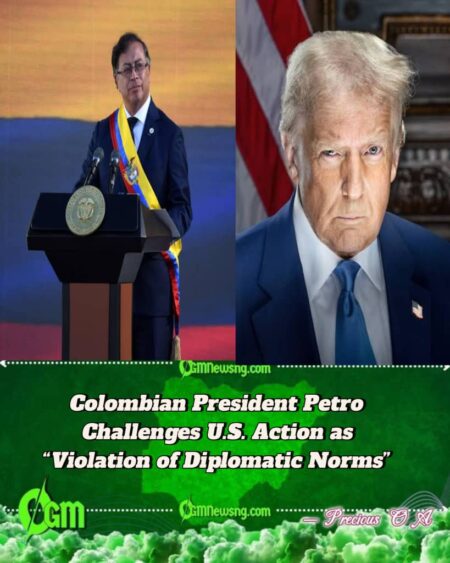
Petro, the current President of Colombia and a former mayor of Bogotá who was elected on a progressive platform in 2022, electrified a crowd of demonstrators outside the United Nations headquarters in New York City last week when he delivered a fiery speech at a pro-Palestinian rally. The left-leaning leader, known for his outspoken positions on human rights and environmental issues, declared that U.S. soldiers should “obey the order of humanity” rather than “inhumane commands” in Gaza. His language, calling for an international armed force “larger than that of the United States” to “liberate Palestinians,” instantly went viral and drew sharp criticism from Washington.
Petro used the moment to frame himself as a defender of global justice, saying that his words reflected not just Colombian policy but a universal moral imperative. He argued that silence in the face of what he called atrocities in Gaza would be complicity. Supporters online praised his courage, contrasting it with what they saw as the muted tone of other Latin American leaders.
Petro had originally traveled to New York to give a formal address at the UN on climate change, inequality, and global peace. However, his impromptu participation at the pro-Palestinian rally quickly overshadowed his official speech inside the General Assembly. International news outlets replayed clips of his remarks for hours, framing them as one of the week’s most dramatic interventions by a foreign leader.
The U.S. State Department responded within hours, calling the comments “reckless and incendiary” and announcing the revocation of his visa. The move shocked many diplomats and marked one of the rare occasions when Washington has taken such a step against a sitting head of state attending UN meetings.
Bogotá’s Defiant Response to Washington’s Decision
Petro discovered the revocation only upon landing back in Bogotá, where he confirmed the news in a post on X (formerly Twitter). Calling it “a grave violation of diplomatic norms,” he asserted that international law grants sitting heads of state immunity to attend UN functions and suggested that the U.S. action broke with decades of precedent.
Petro further argued that, as a dual citizen of Colombia and Europe, he retained certain travel privileges under U.S. visa waiver mechanisms. He described the revocation as “not only illegal but morally indefensible,” hinting that Colombia might seek redress through international forums. His legal team has reportedly begun reviewing whether the decision violates treaties between Washington and Bogotá.
Colombian Interior Minister Armando Benedetti quickly joined the chorus of criticism, accusing the Trump administration of “blatant double standards.” He pointed out that leaders accused of grave human-rights violations had still been welcomed in Washington while the Colombian president was being punished for exercising free speech.
Supporters inside Colombia rallied behind their president, casting him as a principled leader unafraid to speak truth to power. Critics, however, worried that his rhetoric and the resulting diplomatic clash could jeopardize critical U.S. assistance in security and anti-narcotics operations.
Petro’s Position at Home and Abroad
Petro insisted in Colombian media interviews that he would not retract his comments. “I spoke the truth,” he said, “and no visa can silence the defense of human dignity.” He framed the incident as part of a larger struggle over the future of global politics, in which smaller nations must challenge superpowers when moral principles are at stake.
Petro has long cultivated an image of independence on the world stage, emphasizing South–South cooperation and criticizing U.S. foreign policy where he sees hypocrisy. Analysts note that this latest clash fits a pattern of increasingly strained ties between Bogotá and Washington since Trump’s return to the White House.
For many Colombians, the stand resonates with a desire for a more autonomous foreign policy. Opinion polls show that while some fear economic repercussions, a significant portion of the public admires his willingness to confront the United States directly. Editorials in Bogotá’s major newspapers reflected this divide, with some hailing him as a moral voice and others warning of isolation.
Despite the uproar, his government has signaled it will continue working with the United States on shared interests such as trade, migration, and environmental cooperation. Colombian diplomats stress that the relationship is “bigger than any one incident,” even as they lodge formal protests over the visa issue.
Implications for U.S.–Colombian Relations
Petro now finds himself at the center of a test case for diplomatic immunity and free expression at international gatherings. Analysts warn that revoking the visa of a sitting president during the UN General Assembly undermines long-standing practices that protect leaders from such measures, especially when their remarks, however controversial, are delivered in a public forum.
Under President Donald Trump’s second term, U.S.–Colombian relations have already cooled. Earlier this year Washington decertified Colombia as a reliable partner in the war on drugs, citing “insufficient efforts” to curb coca cultivation. The visa clash now extends tensions into new territory, raising questions about future cooperation on security and economic issues.
Diplomatic experts caution that if the rift deepens, Colombia could pivot more strongly toward alternative partners such as the European Union or other Latin American blocs. Such a shift would mark a dramatic realignment for a country that has historically been one of Washington’s closest allies in the hemisphere.
Still, some observers believe the current standoff may eventually give way to pragmatic engagement. U.S. businesses have significant investments in Colombia, and both nations share interests in regional stability. Much will depend on whether the Colombian leader moderates his rhetoric or doubles down on his confrontational approach in the coming months.
Table of Contents
Discover more from OGM News NG
Subscribe to get the latest posts sent to your email.