









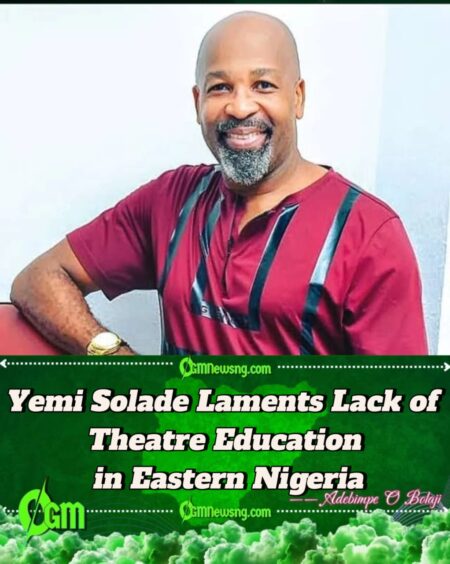
Veteran Nollywood actor, Yemi Solade, has stirred conversations within the entertainment industry after pointing out the glaring absence of structured theatre education in Nigeria’s eastern region. Sharing his personal experience, Yemi Solade explained that during his youth, no institution in the East offered theatre studies, which he believes created a cultural gap that has continued to affect the region’s contributions to Nollywood. He described the lack of such educational opportunities as a huge limitation, preventing the nurturing of creative talents that could have strengthened the industry’s foundation.
The actor further revealed that because of this void, many young and ambitious performers from the East had no choice but to relocate to other parts of the country, especially the West, where formal theatre education was more accessible. This constant migration, according to him, not only stunted the region’s creative independence but also robbed Nollywood of unique cultural flavors that would have emerged if Eastern actors were groomed in their own communities. His remarks have since sparked calls for renewed investment in arts education across Nigeria to balance cultural representation in the film industry.
The Western Dominance in Theatre Studies
Yemi Solade pointed out that the Western region, especially institutions like the University of Ibadan and Obafemi Awolowo University, held a monopoly on structured theatre education for decades. These universities became breeding grounds for notable performers, scriptwriters, and directors who later shaped Nigeria’s entertainment industry.
By contrast, the absence of equivalent institutions in the East created a clear imbalance in the distribution of talent. While the East contributed heavily in terms of raw talent and storytelling traditions, the lack of academic frameworks made it difficult for many to refine their craft within the region.
The Impact on Nollywood’s Evolution
The actor stressed that the absence of theatre schools in the East has had long-term effects on Nollywood’s trajectory. He argued that if the East had built strong theatre departments early enough, Nollywood would have developed a more balanced representation of cultures, traditions, and artistic styles.
Instead, the industry became heavily influenced by Western-trained actors and directors. While this helped standardize Nollywood, it also meant that Eastern storytelling methods were often underrepresented or filtered through external influences.
Cultural Implications of the Gap
Beyond the entertainment industry, Yemi Solade believes the lack of theatre education in the East has broader cultural implications. Theatre, he explained, is not just about acting but also about preserving heritage, language, and collective memory through performance.
With little institutional support, much of the East’s rich cultural expressions have been left undocumented or underexplored. He fears that future generations may lose touch with these traditions unless deliberate efforts are made to invest in cultural education.
Yemi Solade: A Call for Educational Reform
Yemi Solade’s comments serve as a wake-up call for Nigerian policymakers and education stakeholders. He advocates for the establishment of fully equipped theatre departments in Eastern universities to bridge the historical gap and empower young talents who might otherwise leave their communities to pursue training.
Such reforms, he argued, would not only strengthen Nollywood but also boost Nigeria’s cultural economy. By decentralizing theatre education, more diverse stories and authentic voices from the East could gain visibility on global platforms.
Looking Ahead: A Path to Balance
Yemi Solade remains hopeful that the narrative can change if immediate steps are taken. He called on governments, private investors, and cultural institutions to prioritize theatre education as a tool for national identity and industry growth.
He concluded that while Nollywood has made remarkable strides, it can only reach its full potential when every region has equal access to quality theatre education. For him, the time has come to correct past neglect and open new doors for the next generation of actors, writers, and cultural ambassadors.
Table of Contents
Discover more from OGM News NG
Subscribe to get the latest posts sent to your email.