









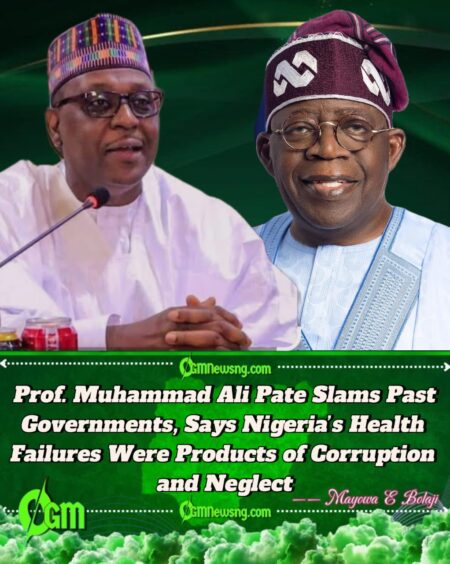
Prof. Muhammad Ali Pate, Minister of Health, emphasized that Nigeria’s public health system is undergoing a fundamental repositioning under President Bola Tinubu. He explained that the reforms are not cosmetic but structural, aimed at creating resilience against global health emergencies such as pandemics and emerging infectious diseases.
Prof. Muhammad Ali Pate noted that for too long, Nigeria’s health institutions have remained fragile and underfunded, leaving citizens vulnerable during crises. He insisted that Tinubu’s administration has mapped out a blueprint to correct these gaps through systemic reforms, stronger regulations, and strategic partnerships with global health bodies.
Tinubu’s Leadership Under Spotlight
Prof. Muhammad Ali Pate underscored that President Bola Tinubu’s health agenda prioritizes investment in infrastructure, digital health innovations, and training of frontline workers. According to him, this vision is crafted to align Nigeria with global standards of preparedness in the 21st century.
Prof. Muhammad Ali Pate added that leadership commitment is key to public health transformation. He stressed that the President’s political will signals a departure from previous administrations where policies were written but seldom implemented. This, he said, is what makes the current reform drive unique.
Tackling Past Failures Head-On
Prof. Muhammad Ali Pate reflected on Nigeria’s poor handling of past health crises, including the Ebola scare, recurring cholera outbreaks, and the COVID-19 pandemic. He maintained that each event exposed systemic weaknesses that endangered millions of citizens.
Prof. Muhammad Ali Pate admitted that corruption, poor coordination, and underinvestment crippled the country’s ability to respond effectively. He explained that the ongoing reforms are designed to close these gaps by introducing accountability frameworks and performance-driven systems in public health management.
Community-Centered Healthcare Delivery
Prof. Muhammad Ali Pate highlighted that the new reforms will not be limited to tertiary hospitals but will trickle down to primary healthcare centers across rural Nigeria. He explained that communities will have direct access to essential medicines, vaccines, and diagnostic services without traveling long distances.
Prof. Muhammad Ali Pate revealed that the government is scaling up its Primary Health Care Revitalization Agenda, which is expected to expand coverage to over 80% of Nigerians. He said this grassroots strategy is essential for equitable healthcare delivery and stronger resilience against epidemics.
Financing and Global Partnerships
Prof. Muhammad Ali Pate confirmed that health financing remains the bedrock of the new agenda. He said Nigeria is mobilizing domestic resources while strengthening partnerships with global health agencies such as the World Health Organization (WHO), Gavi, and the Global Fund.
Prof. Muhammad Ali Pate disclosed that part of the reform involves creating a sustainable health insurance framework. He argued that without reliable financing, no reform can survive, and Nigeria risks repeating the mistakes of the past where donor dependence crippled sustainability.
A Call for Accountability and Vigilance
Prof. Muhammad Ali Pate warned that while reforms look promising, the system will collapse without accountability and strong citizen participation. He challenged civil society and the media to hold the government to its promises, noting that transparency is the soul of public health.
Prof. Muhammad Ali Pate concluded that Nigerians should not view the reforms as mere government rhetoric but as a national survival plan. He declared that in a global era where health threats transcend borders, Nigeria cannot afford complacency. Instead, it must embrace vigilance, innovation, and accountability.
Table of Contents
Discover more from OGM News NG
Subscribe to get the latest posts sent to your email.