









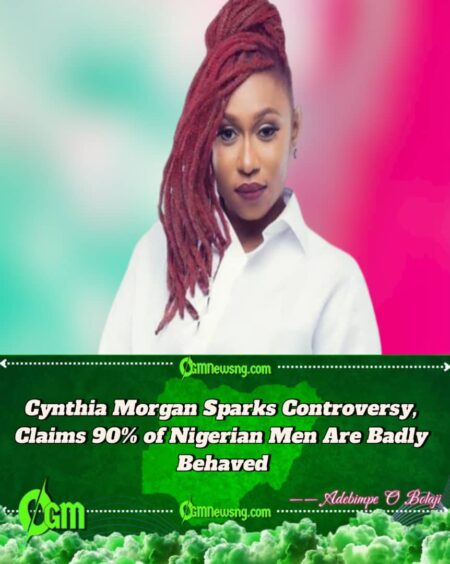
Nigerian dancehall singer, Cynthia Morgan, has set social media abuzz after declaring that 90 percent of Nigerian men are badly behaved. The outspoken artiste, who is no stranger to making bold statements, made this revelation while addressing issues of morality and relationship culture among men in the country.
According to her, the behaviors displayed by most men reflect deep-seated flaws in character, ranging from dishonesty to lack of respect for women. She emphasized that this is not a mere personal opinion but a conclusion drawn from her observations and personal experiences over the years.
Social Media Reactions to Cynthia Morgan’s Statement
Immediately after her remark surfaced online, Nigerians on X (formerly Twitter), Instagram, and Facebook trooped into the comment sections to either defend or criticize her position. While some users applauded her for speaking the “hard truth,” others accused her of overgeneralizing and unfairly painting Nigerian men in a negative light.
The online backlash did not deter Cynthia Morgan, as she doubled down, insisting that the statistics she presented are even modest compared to the reality she perceives. Netizens, however, continue to argue on whether her assessment is a reflection of widespread reality or just a personal bias based on her past experiences.
Historical Context: Cynthia Morgan’s Troubled Journey with Men
Cynthia Morgan’s relationship history has often made headlines, with tales of heartbreak, betrayal, and strained partnerships shaping public perception of her personal life. Many critics now link her strong views to her own difficult experiences, suggesting her statement may be fueled by unresolved emotional wounds.
Nonetheless, her defenders argue that lived experiences are powerful indicators of societal behavior. They insist that the singer, having interacted with diverse individuals in the entertainment industry and beyond, is qualified to speak on issues of character and moral conduct among Nigerian men.
Gender Dynamics and the Debate on Male Behavior in Nigeria
Her claim has reignited conversations about gender dynamics and the behavioral expectations of men in Nigerian society. For decades, women have voiced concerns over dishonesty, infidelity, lack of accountability, and gender-based violence allegedly perpetuated by men. Cynthia Morgan’s statement, though blunt, seems to echo these wider concerns.
Sociologists suggest that such discourse, though controversial, forces society to confront uncomfortable truths. By spotlighting the perceived negative conduct of men, it opens the floor for discussions on accountability, respect, and the urgent need for a cultural shift in gender relations.
Public Opinion Polls and Realities on Nigerian Men
Interestingly, some research and opinion polls have mirrored aspects of Cynthia Morgan’s statement. A recent survey conducted by independent social commentators highlighted that a significant percentage of Nigerian women expressed dissatisfaction with male behavior in areas of honesty and relationship commitment.
However, critics caution against blanket statistics that seem to demonize men as a whole. They argue that while negative conduct exists, there are also countless Nigerian men who are responsible, respectful, and upright. The problem, according to them, lies in amplifying only the negative without acknowledging the positive.
What Cynthia Morgan’s Statement Means for Future Conversations
Beyond the outrage, Cynthia Morgan’s controversial statement has reawakened a deeper debate on morality, gender relations, and the need for behavioral reform among Nigerian men. By boldly placing a figure on her claim, she has drawn attention to the urgent necessity for society to address issues of respect, accountability, and character development.
As the conversations continue, one thing remains clear: Cynthia Morgan has once again succeeded in using her platform to provoke thought and ignite nationwide discourse. Whether Nigerians agree with her or not, the discussion she sparked will likely remain in the public space for a long time, pushing for introspection on both individual and societal levels.
Table of Contents
Discover more from OGM News NG
Subscribe to get the latest posts sent to your email.