
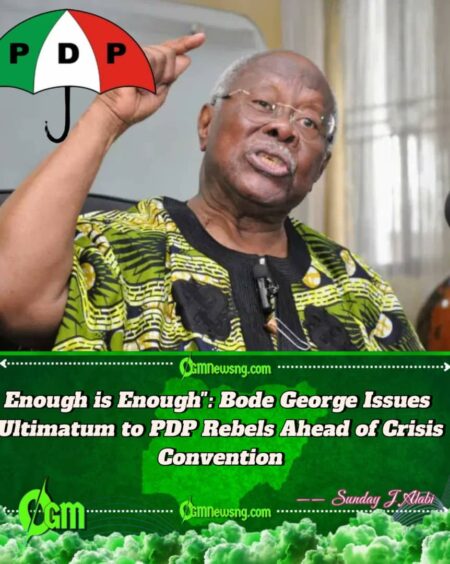
Chief Olabode George, a prominent chieftain of the People’s Democratic Party (PDP), has delivered a stern warning to party members undermining internal unity, declaring that those acting as “progress terminators” should leave the organization immediately. Speaking during a Friday interview with ARISE NEWS, George emphasized that the party must enforce strict discipline to maintain its credibility as Nigeria’s leading opposition force ahead of its upcoming national convention.
The former military administrator’s comments come at a critical juncture for the PDP, which has been grappling with internal disputes and leadership challenges that have forced what was originally planned as a non-elective convention to become a contested leadership election. George’s remarks signal growing impatience among party veterans with ongoing internal dissent that threatens the organization’s unity and electoral prospects.
PDP Must Enforce Discipline Against Internal Saboteurs
George minced no words in his assessment of party members he views as disloyal, categorizing them into two distinct groups that reflect the current internal dynamics of Nigeria’s main opposition party. “In life, you have those that can be termed as progress terminators, and also success accelerators,” he stated emphatically during the interview. “If you want to be a progress terminator, please ship yourself out. And the party must be strong enough to take that decision. Period.”
The veteran politician’s language reflects mounting frustration within certain quarters of the PDP over what they perceive as deliberate attempts by some members to undermine party decisions and create unnecessary divisions. George argued that the party’s tolerance for such behavior has reached its breaking point, insisting that decisive action is now required to preserve the organization’s integrity and effectiveness.
His comments suggest that the PDP leadership is considering more aggressive measures to deal with internal dissent, marking a potential shift from the party’s traditionally inclusive approach to managing diverse opinions within its ranks. George’s call for the party to be “strong enough” to make tough decisions indicates that expulsions or disciplinary actions against prominent members may be under consideration.
Convention Transformed from Routine to Crisis Management Exercise
The upcoming PDP national convention, originally conceived as a routine non-elective gathering, has been fundamentally transformed due to ongoing internal crises and unexpected leadership departures. George explained that the party’s National Executive Committee (NEC) was forced to convert the event into an elective convention following significant disruptions to the party’s leadership structure.
“This particular convention that is coming would just have been a non-elective convention. But because of the crisis we have gone through, and the resignation of some of the principals, NEC decided it has to be an elective convention,” George revealed. The change underscores the depth of the leadership challenges facing the party, which has struggled to maintain stability since its defeat in the 2023 general elections.
The transformation of the convention format represents more than a procedural adjustment; it reflects the party’s acknowledgment that significant structural changes are needed to address its current difficulties. The decision to hold elections for key positions suggests that the existing leadership arrangement has been deemed inadequate to navigate the party through its current challenges and prepare it for future electoral contests.
Zoning Committee Tasked with Resolving Geopolitical Balance Issues
Central to the current party crisis is the work of a zoning committee established by the PDP’s National Executive Committee to review leadership arrangements across Nigeria’s six geopolitical zones. George emphasized that this committee’s mandate extends beyond simple administrative reorganization to address fundamental questions about political representation and national balance that have long been central to the PDP’s identity.
The zoning principle, which George traced back to 1998, represents one of the PDP’s core organizational philosophies and has been instrumental in maintaining internal cohesion across Nigeria’s diverse political landscape. “There are six geopolitical zones, and six top positions in the country. That was the understanding since 1998. Everybody must have a sense of belonging. That is the difference between us and others,” he explained.
George’s emphasis on the zoning arrangement highlights the party’s continued commitment to rotational leadership as a mechanism for ensuring equitable representation across Nigeria’s diverse regions. He argued that abandoning or undermining these principles would not only damage the party internally but could also threaten broader national stability by disrupting the delicate balance that has helped maintain political cohesion across Nigeria’s complex ethnic and regional divisions.
Collective Responsibility Versus Individual Ambition
In drawing distinctions between the PDP and the ruling All Progressives Congress (APC), George emphasized what he views as fundamental philosophical differences in party organization and leadership structure. He argued that while the APC operates under a highly centralized system dominated by presidential authority, the PDP maintains a more democratic and collective approach to decision-making.
“The difference between the PDP and the APC is as clear as a crystal. In APC, there is only one man who can speak to the heart of the party—the president. In PDP, no individual owns the party. It is collective responsibility,” George stated. This characterization positions the PDP as offering a more democratic alternative to what he portrays as the authoritarian tendencies of the ruling party.
However, George also made clear that collective responsibility requires individual sacrifice and subordination of personal ambitions to party decisions. He expressed particular frustration with members who prioritize their individual political interests over party unity, arguing that such behavior represents a betrayal of the collective trust that underpins the organization’s democratic principles.
Final Ultimatum: Comply or Leave
George concluded his intervention with what amounts to an ultimatum to dissenting party members, making clear that continued accommodation of internal opposition is no longer sustainable. He called for definitive action at the upcoming NEC meeting, warning that failure to address the current crisis decisively would result in further deterioration of party unity and effectiveness.
“This NEC meeting must extract all these misgivings, and if the party does not make a decisive decision, we will just go back and vote no. Enough is enough,” George declared. His warning carries particular weight given his status as one of the party’s founding figures and his continued influence within party circles.
The veteran politician’s final message emphasized that the PDP must present itself as a disciplined and united organization if it hopes to maintain its position as Nigeria’s premier opposition party. He argued that the party’s credibility with the electorate depends not just on its policy positions but on its ability to demonstrate effective internal management and cohesive leadership. George’s intervention represents a clear escalation in the internal debate over party discipline and suggests that significant changes to the PDP’s membership and leadership structure may be imminent as the organization prepares for its crucial national convention.
Table of Contents
Discover more from OGM News NG
Subscribe to get the latest posts sent to your email.