









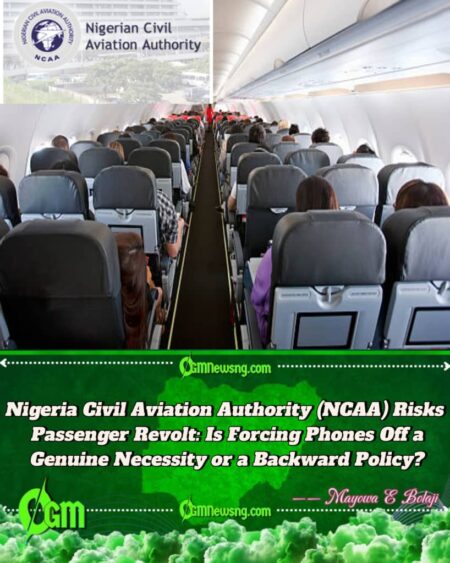
Nigeria Civil Aviation Authority (NCAA) has issued a new directive mandating that all mobile phones must be completely switched off during the critical phases of flight—take-off and landing. The aviation regulator insists that the move is not merely a routine reminder but a strict enforcement order intended to safeguard lives.
Nigeria Civil Aviation Authority (NCAA) emphasized that the decision followed growing concerns from pilots who have reported potential cockpit interference from passenger devices. By enforcing a full shutdown instead of “airplane mode,” the agency seeks to eliminate every possible risk linked to electromagnetic signals during these vulnerable stages of flight.
NCAA Battles the Myth of Airplane Mode Safety
Nigeria Civil Aviation Authority (NCAA) openly dismissed the widespread belief that enabling “airplane mode” on smartphones is enough to guarantee safety. The agency argued that several devices still emit residual signals that may disrupt sensitive aircraft communication and navigation systems.
Nigeria Civil Aviation Authority (NCAA) pointed to incidents in global aviation history where unexplained cockpit anomalies coincided with passenger non-compliance. Though such occurrences are rare, the agency warned that even the slightest distraction could result in catastrophic consequences during take-off or landing.
NCAA Faces Passenger Backlash and Public Skepticism
Nigeria Civil Aviation Authority (NCAA) is now facing mounting criticism from passengers who believe the directive is exaggerated and unnecessary. Many travelers argue that airlines worldwide permit “airplane mode” without any proven record of accidents caused by mobile interference.
Nigeria Civil Aviation Authority (NCAA), however, insists that its role is to prevent potential dangers before they spiral into tragedy. Critics see this as an overreach that could trigger confrontation between crew and passengers, especially in an era where people rely heavily on their devices for work, safety, and personal communication.
Nigeria Civil Aviation Authority Stresses Compliance or Risk Flight Delays
Nigeria Civil Aviation Authority (NCAA) has warned that non-compliance with the directive could result in disciplinary actions, including grounding flights or penalizing airlines. Pilots have been instructed to delay take-off if passengers refuse to switch off their phones completely.
Nigeria Civil Aviation Authority (NCAA) added that cabin crew will undergo stricter training on how to enforce this rule without escalating conflicts inside the aircraft. The agency emphasized that aviation safety takes precedence over convenience, and compliance is non-negotiable.
Nigeria Civil Aviation Authority Faces International Scrutiny Over New Policy
Nigeria Civil Aviation Authority may now have to defend its controversial stance before international aviation bodies. Many regulators, including the U.S. Federal Aviation Administration (FAA) and the European Union Aviation Safety Agency (EASA), allow the use of airplane mode without requiring full shutdown.
Nigeria Civil Aviation Authority risks being perceived as alarmist if it cannot provide empirical evidence to back its decision. Aviation experts argue that unless concrete proof is presented, Nigeria could face reputational damage in global aviation circles.
Nigeria Civil Aviation Authority Defends Directive as Proactive Safety Culture
Nigeria Civil Aviation Authority insists that its strict measures represent a proactive safety culture rather than a reactive one. The agency believes that preventing even the smallest chance of interference is worth the inconvenience passengers may experience.
Nigeria Civil Aviation Authority concluded that aviation safety is built on precautionary principles, not convenience. By taking this hardline position, the authority claims it is prioritizing Nigerian lives above comfort, even if the decision sparks heated controversy in the skies and on the ground.
Table of Contents
Discover more from OGM News NG
Subscribe to get the latest posts sent to your email.