








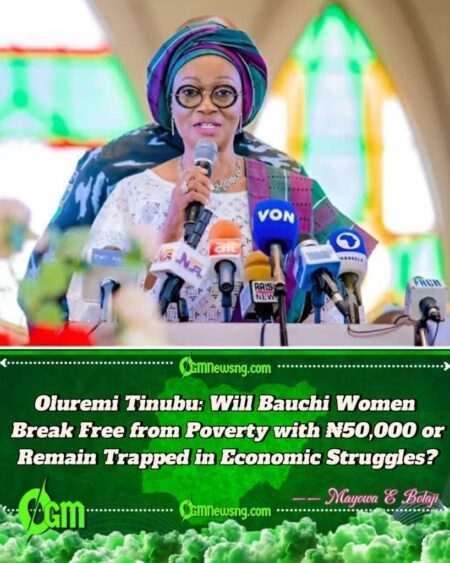
Oluremi Tinubu, Nigeria’s First Lady, unveiled a ₦250 million empowerment package for 500 Bauchi women under the Renewed Hope Initiative (RHI). Each beneficiary received ₦50,000 in cash support, targeted at boosting small-scale businesses and household ventures. The initiative was staged as a bold step to uplift women who have been economically sidelined in northern Nigeria.
Oluremi Tinubu emphasized that the funds were not charity but an investment in women’s resilience and resourcefulness. However, critics question whether such tokenistic payouts can trigger lasting wealth creation or simply serve as temporary palliatives in a state plagued by high poverty and unemployment.
Empowerment or Poverty Management Scheme?
Oluremi Tinubu described the initiative as part of a larger nationwide mission to strengthen women-led businesses and reduce economic inequalities. Her message resonated with many attendees who saw the gesture as a long-awaited recognition of women’s struggles in rural commerce.
Oluremi Tinubu, however, faces criticism from activists who argue that ₦50,000 per woman is insufficient in today’s inflation-driven economy. Many point out that the disbursement risks being consumed in household expenses rather than serving as real seed capital for sustainable enterprises.
Renewed Hope Initiative Under the Microscope
Oluremi Tinubu stated that the Renewed Hope Initiative was designed to promote inclusive growth across Nigeria, reaching grassroots communities often neglected by policy frameworks. In Bauchi, the programme is positioned as a lifeline for women left behind in mainstream financial systems.
Oluremi Tinubu’s efforts are nonetheless attracting skepticism, with policy analysts warning that without monitoring mechanisms, the disbursed funds could be mismanaged. The absence of financial literacy training, market access support, and mentorship raises concerns about the programme’s long-term viability.
The Politics Behind Empowerment Packages
Oluremi Tinubu has framed the empowerment as a non-partisan humanitarian intervention, stressing that every Nigerian woman deserves equal opportunities. She highlighted that the initiative cuts across political affiliations, religion, and ethnicity.
Oluremi Tinubu’s statement has not silenced political commentators who view the empowerment drive as a soft power strategy ahead of looming elections. With Bauchi being a battleground state, the initiative could be seen as part of a subtle campaign to woo women voters and strengthen APC’s grassroots influence.
Northern Women and the Struggle for Economic Independence
Oluremi Tinubu declared that the programme would amplify the voices of northern women, who remain marginalized in Nigeria’s socio-economic structure. She underscored women’s capacity to reshape communities when equipped with the right tools and financial support.
Oluremi Tinubu’s assertion collides with ground realities, where systemic barriers such as patriarchy, illiteracy, and limited market access continue to stifle women entrepreneurs. Analysts argue that without dismantling these structural inequalities, cash transfers alone will not deliver transformative change.
Will ₦50,000 End Bauchi’s Poverty Cycle?
Oluremi Tinubu concluded that her goal is to ignite a ripple effect of empowerment, where women beneficiaries would reinvest their earnings and grow thriving businesses. She expressed optimism that the ₦50,000 seed fund could spark financial independence in households across Bauchi.
Oluremi Tinubu’s optimism is being contested, as economists warn that the intervention risks becoming another unsustainable handout programme. Unless paired with accountability measures, skill development, and access to scalable markets, Bauchi women may find themselves back in poverty cycles once the funds dry up.
Table of Contents
Discover more from OGM News NG
Subscribe to get the latest posts sent to your email.