








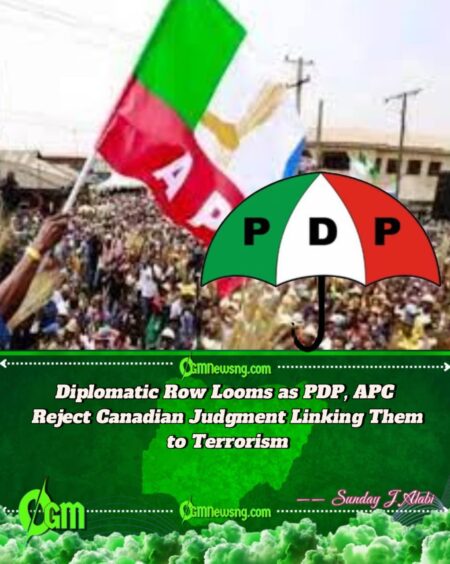
Nigeria’s two largest political parties — the Peoples Democratic Party (PDP) and the All Progressives Congress (APC) — have strongly rejected a ruling by the Federal Court of Canada classifying both organisations as “terrorist entities.”
The judgment, delivered on June 17, 2025, by Justice Phuong Ngo, upheld a decision of Canada’s Immigration Appeal Division (IAD), which denied asylum to Nigerian national Douglas Egharevba. Court records revealed that Egharevba had been a member of the PDP between 1999 and 2007 before switching allegiance to the APC, where he remained until his relocation to Canada in 2017.
According to filings, the Canadian Minister of Public Safety and Emergency Preparedness argued that both parties had a history of complicity in political violence, democratic subversion, and election-related bloodshed. The PDP’s conduct during the 2003 state elections and the 2004 local government polls was cited as evidence, with references to ballot stuffing, voter intimidation, and killings of opposition supporters.
Legal Basis for the Controversial Verdict
The IAD concluded that leaders of both parties benefited from political violence and failed to take steps to curtail it, thereby meeting Canada’s legal definition of subversion under paragraph 34(1)(b.1) of the Immigration and Refugee Protection Act (IRPA). Justice Ngo further affirmed that under paragraph 34(1)(f) of the IRPA, “mere membership of an organisation linked to terrorism or democratic subversion” could trigger inadmissibility to Canada, irrespective of whether the individual was personally involved in acts of violence.
This interpretation has stirred outrage in Nigeria, where the ruling is seen not just as a rebuke of individual conduct but as a sweeping indictment of the nation’s political framework. Critics warn that the decision could extend beyond Egharevba’s asylum case, shaping how Western democracies view Nigerian politics.
Verdict ‘Misinformed, Biased, and Lacking Evidence’ – PDP
Reacting sharply, the PDP condemned the ruling as “misinformed, biased, and lacking evidence.” PDP Deputy National Youth Leader, Timothy Osadolor, dismissed the judgment, insisting that both Nigeria and Canada are democracies where freedom of speech must not be abused with “unguarded and unnecessary statements.”
Osadolor argued that while some individuals in government may face allegations of connections to extremist groups, painting entire political organisations as terrorist outfits was both “unfounded and dangerous.” He described the PDP as a “credible institution” and warned that such foreign court rulings could undermine Nigeria’s democratic processes.
Former Nigerian National Petroleum Company spokesperson, Olufemi Soneye, echoed similar concerns. He warned that if democratic nations fail to challenge the precedent, foreign courts could begin putting other countries’ political systems “on trial.” He further cautioned that branding established political parties as terrorist groups could have far-reaching consequences — including visa denials, heightened international scrutiny, and erosion of civil liberties at home.
‘No Jurisdiction, No Legitimacy from a Foreign Bench’ – APC
The APC was equally scathing in its reaction. Its National Secretary, Senator Ajibola Bashiru, dismissed the Canadian ruling as “baseless,” branding the presiding judge “an ignoramus.” He stressed that the APC is a credible democratic organisation and does not seek validation from foreign jurisdictions that lack extraterritorial authority.
Bashiru argued that the Canadian court had “no jurisdiction” to determine the status of Nigerian political parties, let alone label them terrorist organisations. He described the ruling as “delivered from a jaundiced perspective” within the narrow context of an asylum case, not an international tribunal.
He further lamented that unpatriotic Nigerians seeking asylum abroad had created avenues for Nigeria’s democracy to be maligned by “racist judges” and foreign institutions unfamiliar with the nation’s complexities. The APC, like the PDP, called for a focus on individual accountability rather than wholesale judgments that could damage diplomatic ties.
Implications for Nigeria–Canada Relations
Both political parties have united in their condemnation of the ruling, warning that it could distort Nigeria’s democratic image on the global stage. Analysts suggest that if such judgments gain traction in Western democracies, Nigeria’s political class may face greater international scrutiny, with implications for asylum applications, diplomatic relations, and even economic cooperation.
While Canadian authorities insist their decision was grounded in legal precedent, Nigerian political leaders argue that it reflects a misunderstanding of the nation’s political evolution since 1999. They caution that indiscriminate labeling of mainstream parties risks not only delegitimising Nigeria’s democracy but also undermining efforts at international cooperation in areas such as counterterrorism, migration, and governance.
The judgment, though specific to an asylum claim, has triggered a diplomatic storm that could escalate unless both nations engage in dialogue. For now, the PDP and APC appear united in their stance — a rare convergence between Nigeria’s bitter political rivals.
Table of Contents
Discover more from OGM News NG
Subscribe to get the latest posts sent to your email.