









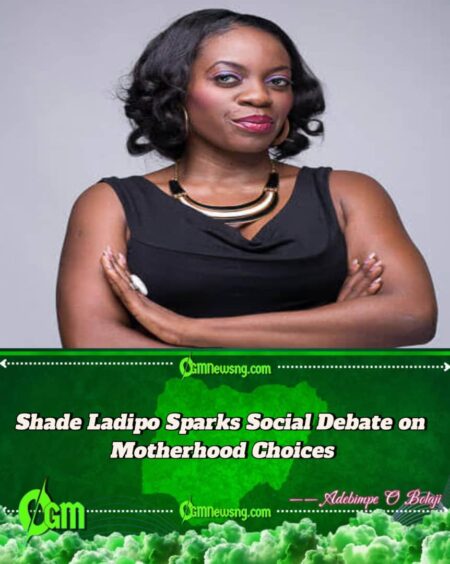
Popular Nigerian media personality Shade Ladipo has sparked widespread debate after boldly declaring, “It’s 2025, it’s not impossible to be pregnant even if you are single.” Sharing the statement in a recent Instagram post, the outspoken broadcaster challenged long-standing societal expectations that motherhood must be linked to marriage. Known for her fearless opinions on women’s rights and social change, Ladipo used the moment to highlight the realities of modern reproductive options such as IVF, surrogacy, and artificial insemination, stressing that women should have the freedom to choose when and how to become mothers without societal pressure.
Her remarks come amid a growing wave of conversations in Nigeria about reproductive rights, evolving relationship structures, and the redefinition of family norms. The statement drew mixed reactions, with supporters applauding her for championing female autonomy, while critics accused her of promoting values that clash with traditional African beliefs. Cultural commentators note that her stance reflects a generational shift, as younger Nigerians increasingly embrace unconventional life choices, signaling that the debate on single motherhood in the country is far from over.
Embracing Modern Fertility Options
In her post, Shade Ladipo hinted at the growing accessibility of assisted reproductive technologies such as in-vitro fertilization (IVF), artificial insemination, and surrogacy. She suggested that women no longer have to wait for a “perfect” partner before choosing to become mothers.
The statement reflects a shift in how younger generations view family planning. With technological advancements making pregnancy possible outside the traditional marital setup, Ladipo’s message challenges cultural norms that once strictly dictated the “right time” to have a child.
Nigeria’s Conservative Society Faces a Modern Reality
While single motherhood is not a new phenomenon in Nigeria, it has historically been stigmatized. Many traditionalists still hold firm to the belief that childbearing should happen within marriage.
Shade Ladipo’s statement forces a direct confrontation with these norms. By framing her point within the context of 2025, she emphasizes the inevitability of change — and the fact that reproductive autonomy is becoming a more widely accepted conversation.
Public Reactions: Praise and Pushback
Social media users quickly weighed in on the controversial statement. Supporters applauded her for empowering women to make independent choices about their bodies and futures. They praised her courage in openly discussing a topic many avoid in public forums.
Critics, however, accused her of encouraging what they view as the erosion of traditional family values. Some questioned whether the cultural shift she envisions could create new social challenges for children raised outside conventional households.
Shade Ladipo’s Track Record of Bold Opinions
This is not the first time Shade Ladipo has sparked conversation with her views. Over the years, she has built a reputation for fearless commentary on gender equality, women’s rights, and societal double standards.
Her latest statement is consistent with her advocacy for female autonomy, which often challenges the intersection of culture, religion, and modernity. In the past, she has addressed sensitive issues such as divorce, career-first lifestyles, and the right of women to prioritize personal happiness.
Broader Implications for Women’s Empowerment in 2025
Shade Ladipo’s comment underscores a broader shift in African societies where women are increasingly taking charge of their life decisions. As fertility technology continues to advance, the conversation around reproductive rights is likely to grow louder.
For many women, her message is less about rejecting marriage and more about reclaiming agency. Whether Nigeria’s cultural climate is ready to fully embrace this perspective remains to be seen — but in 2025, the dialogue is clearly no longer avoidable.
.
Table of Contents
Discover more from OGM News NG
Subscribe to get the latest posts sent to your email.