




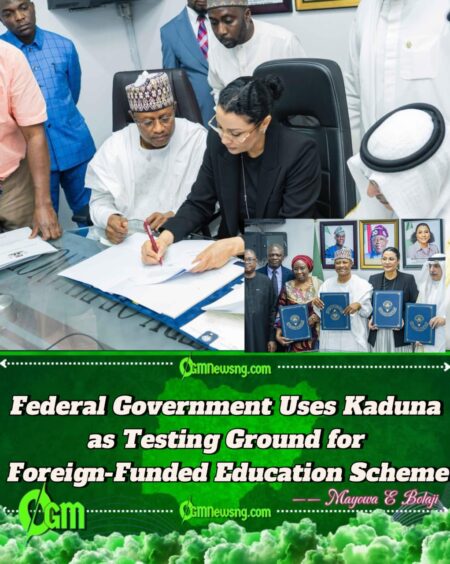
The Federal Government has entered a $62.8 million Memorandum of Understanding with the Kuwait Fund for Arab Economic Development (KFAED), earmarked to tackle Nigeria’s out-of-school children crisis—starting with Kaduna State. The initiative, hailed as groundbreaking, is part of the Reaching Out-of-School Children (ROOSC) project aimed at constructing and rehabilitating hundreds of educational facilities.
The Federal Government describes this as a “first-of-its-kind” partnership with KFAED, positioning it as a critical diplomatic and developmental win. However, critics argue that while the figures are impressive on paper, past precedents show a worrisome lack of transparency in similar international funding arrangements—raising early concerns over implementation, mismanagement, and real impact.
Kaduna Becomes Guinea Pig in Federal Education Gamble
The Federal Government, through Governor Uba Sani’s administration, has chosen Kaduna State as the pilot location for the ROOSC initiative—setting the tone for what could either be a blueprint for nationwide reform or a financial misstep. The project proposes the construction of 102 climate-resilient schools and the rehabilitation of 170 learning centers across Kaduna’s 23 Local Government Areas.
While the State Government boasts of fulfilling its counterpart funding obligations and massive investment in education since 2023, observers question whether Kaduna has the infrastructure, capacity, and transparency mechanisms in place to handle a project of such scale and ambition. There is also debate about whether political motives are intertwined in making Kaduna the flagship for the Federal Government’s new international education agenda.
International Applause or Soft Diplomacy Trojan Horse?
The Federal Government lauded the involvement of high-profile international partners including the Islamic Development Bank, Global Partnership for Education, Save the Children International, and UNICEF. Officials present the ROOSC program as a locally-rooted but globally-supported education rescue operation.
However, civil society watchdogs have warned that foreign donor involvement—particularly from politically and religiously aligned organizations—could become a tool of soft diplomacy. There is growing concern that some partners may push socio-cultural narratives that could clash with Nigeria’s secular educational framework, especially in vulnerable communities where schooling already faces deep-rooted resistance.
Is ROOSC the Cure or a Cosmetic Band-Aid for 18 Million Out-of-School Children?
The Federal Government emphasizes that the ROOSC program is aligned with Sustainable Development Goal 4 (SDG 4), seeking to remove barriers that prevent over 18 million Nigerian children from attending school. Officials claim the approach is “community-driven” and addresses inclusivity for girls, children with disabilities, and internally displaced persons.
Yet, education analysts argue that even if the infrastructure is delivered, systemic problems—teacher shortages, curriculum gaps, insecurity, and socio-economic instability—remain unaddressed. “Bricks and mortar don’t teach children,” one expert stated, questioning whether Nigeria is prioritizing PR-friendly announcements over deep structural reform.
$62.8M Price Tag: Transparency, Corruption Fears Linger
The Federal Government insists that accountability and transparency will guide the ROOSC initiative’s execution, noting that Kaduna has mechanisms in place for implementation oversight. Nevertheless, Nigeria’s poor track record in managing foreign development funds casts a long shadow over the announcement.
Anti-corruption bodies and policy think tanks are calling for real-time public dashboards, community monitoring, and periodic audits. Without these measures, they warn, the project could become yet another well-funded but failed initiative, leaving millions of vulnerable children behind while enriching a select few within the system.
Kuwait Fund’s Debut in Nigeria: Strategic Humanitarianism or Strategic Leverage?
The Federal Government hails the ROOSC deal as Kuwait Fund’s first intervention in Nigeria, framing it as a diplomatic milestone. The presence of high-level representatives such as Dr. Waleed Al-Bahar at the signing ceremony reinforces the gravity of the partnership.
Still, geopolitical analysts believe that KFAED’s entrance into Nigeria’s developmental landscape could signal the beginning of strategic economic influence from Gulf nations. They urge the Nigerian government to approach such engagements with sovereign caution, ensuring that developmental help does not become a pawn in foreign policy chess games.
Table of Contents
Discover more from OGM News NG
Subscribe to get the latest posts sent to your email.