









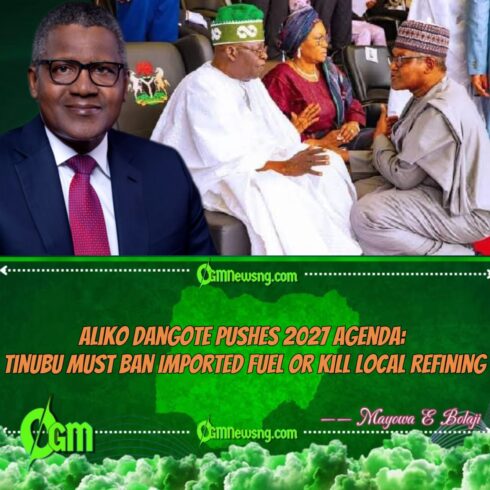
Africa’s richest man, Alhaji Aliko Dangote, has challenged President Bola Tinubu to ban the importation of refined petroleum products, invoking the administration’s own “Nigeria First” policy. Speaking during the West African Refined Fuel Markets Conference, Dangote took a bold and controversial stand against what he termed “toxic dumping” of cheap and substandard fuel in Nigeria.
With Tinubu’s May directive banning government agencies from importing goods locally available, Dangote argued it was only logical to apply this same principle to petrol, diesel, and other refined fuels—especially now that Dangote Refinery is active. “Why should we continue to depend on foreign refineries when Nigeria has the largest single-train refinery in the world?” he asked pointedly.
“Toxic Dumping”: Dangote Warns Against Cheap Foreign Fuel
Aliko Dangote didn’t mince words, accusing global players—especially those dealing in Russian discounted crude—of flooding Africa with unsafe and unfairly priced fuels. “These are petroleum products that would never be allowed in Europe or North America,” he warned, adding that much of this fuel is substandard and harmful to the environment and public health.
He further lamented that price caps on Russian fuels have given rise to a glut of “dumped” products now dominating African markets. These products undercut the cost of Nigerian-refined fuel, even though local refineries, including his, use full crude pricing, making the competition “unjust and unsustainable.”
Nigerian Market Suffers Price War—Fuel Now Cheaper Than in Saudi Arabia
In a startling revelation, Dangote stated that refined fuel is now selling in Nigeria at just 60 cents per liter, cheaper even than in Saudi Arabia, a country with full upstream and downstream capacity. He emphasized that such artificially low prices result from massive dumping rather than efficient pricing.
“Petrol and diesel are now sold for about a dollar net of taxes globally, but in Nigeria, the same products go for just 60 cents. That tells you we are importing cheap, subsidized trash,” Dangote declared. He called the situation a direct threat to Nigeria’s economic sovereignty and energy security.
Marketers Push Back: “Banning Imports Will Create Monopolies”
Not everyone is in favor of Dangote’s suggestion. Petroleum marketers, under the aegis of the Depot and Petroleum Products Marketers Association (DAPPMA) and Independent Petroleum Marketers Association of Nigeria (IPMAN), cautioned the government against making any hasty bans on fuel imports.
Their concern? “Allowing one refinery to control the entire market will stifle competition and drive up prices,” a senior marketer said under anonymity. They argue that import bans will create a virtual monopoly, stifle supply chain diversity, and remove critical checks and balances in pricing and quality control.
Dangote Refinery at the Heart of the Storm
The 650,000 barrels-per-day Dangote Refinery, which officially commenced operations earlier this year, is poised to become a major player in Nigeria’s fuel supply chain. The refinery, located in the Lekki Free Trade Zone, is expected to meet Nigeria’s total domestic consumption and export surpluses across West Africa.
But with the facility still ramping up to full capacity, some industry experts warn that imposing a fuel import ban could create supply shortages and bottlenecks—especially if any disruptions occur at Dangote’s plant. The stakes are high, and the nation’s fuel future hangs in the balance.
Tinubu’s Dilemma: Nationalism vs. Free Market
President Tinubu now faces a thorny decision. Should he protect local production in line with the “Nigeria First” policy, or maintain fuel import flexibility to keep prices competitive and prevent monopolistic control? Either decision carries massive political and economic weight.
With inflation surging and public discontent growing over rising living costs, banning cheaper imported fuels might cause further unrest. Yet ignoring Dangote’s call could derail local industrial investment and weaken domestic refining efforts—precisely what the “Nigeria First” policy seeks to prevent.
Table of Contents
Discover more from OGM News NG
Subscribe to get the latest posts sent to your email.