







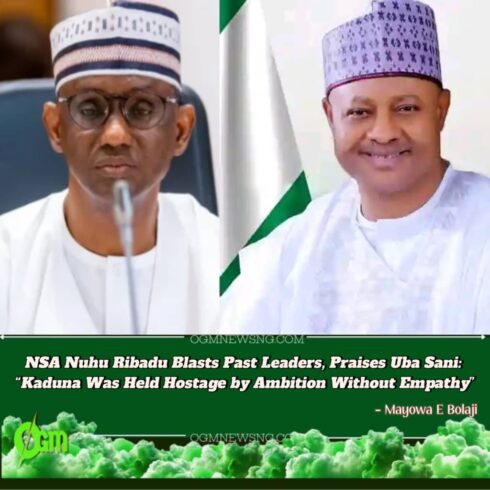
NSA, Mal. Nuhu Ribadu, delivering President Bola Ahmed Tinubu’s message, hailed Governor Uba Sani’s leadership in turning Kaduna from a blood-soaked flashpoint of terrorism into a beacon of peace and development. Speaking at the Phase 1 commissioning of the Qatar Charity Sanabil Project, Ribadu stated firmly: “Your Excellency, Governor Uba Sani, the People’s Governor. Under your stewardship, Kaduna is transforming from an epicenter of violent attacks to a model of stability and peace.”
He emphasized that Kaduna’s turnaround was not coincidental but a product of deliberate policy, stakeholder engagement, community trust-building, and tireless action against insurgents and criminal gangs. “President Tinubu is proud of what Kaduna has become—a rallying point for security architecture reform,” Ribadu added. The comment stirred a wave of discussion across Nigeria’s security circles and social media.
Tinubu’s Message to Kaduna: A Model for National Replication
NSA Ribadu, while delivering the president’s commendation, highlighted Kaduna as a prototype of Tinubu’s Renewed Hope Agenda in action. “The security gains here are tangible, the development visible, and the peace palpable. Mr. President urges other governors to emulate this integrated governance style,” he declared, drawing applause from the dignitaries.
This endorsement is particularly significant amidst growing public anxiety over security lapses in other northern states. Tinubu’s indirect rebuke of states “yet to decentralize their internal security” has triggered political reactions, especially from opposition-ruled areas. Analysts say Kaduna might now become a strategic benchmark for federal resource prioritization in counter-terrorism programs.
Qatar Charity Sanabil Project: Soft Power Meets Security Policy
In a poignant shift from hard military tactics to development diplomacy, the Sanabil Project represents a partnership between foreign aid and local governance to address root causes of extremism. Ribadu described the project as a “strategic buffer” against radicalization, offering education, jobs, and healthcare instead of bullets and boots.
Kaduna’s residents, long traumatized by years of kidnappings, mass killings, and displacement, now see this initiative as a turning point. “What we are doing here is not charity—it’s preemptive peace,” Ribadu stated. Security experts say integrating such foreign development capital into local stabilization frameworks could be Nigeria’s new anti-insurgency blueprint.
Uba Sani’s Hidden War: Quiet Negotiations, Strategic Neutralizations
Without delving into classified operations, Ribadu subtly referenced Uba Sani’s behind-the-scenes diplomacy with rural stakeholders, vigilante networks, and even repentant militants. “Some wars are not won with bullets, but with dialogue, dignity, and deliberate silence,” he noted cryptically.
This comment has reignited debate over the legality and ethics of negotiated peace, especially with groups previously designated as terrorist organizations. Yet, human rights advocates argue that Sani’s pragmatic mix of kinetic and non-kinetic methods is precisely why Kaduna is now safer than many of its neighbors. Ribadu’s endorsement has only given further credibility to this “quiet counterinsurgency.”
A Subtle Swipe at Past Leadership? Ribadu’s Words Spark Political Waves
While Ribadu carefully avoided naming previous Kaduna administrators, his remark—“Kaduna is no longer held hostage by ambition without empathy”—sent tongues wagging. Was this a dig at Nasir El-Rufai’s often-criticized confrontational approach? Or a more general critique of transactional governance?
Political analysts argue that Ribadu’s praise of Uba Sani’s “inclusive and bottom-up model of governance” may have created unintended friction among Kaduna’s political elite. The former governor’s supporters have already taken to social media to “clarify” their own contributions to today’s peace. Whatever the case, the NSA’s words were neither flippant nor hollow—they were loaded with subtle undertones.
Kaduna’s Path Forward: Between Global Humanitarianism and Local Security Synergy
Ribadu concluded with a policy proposal urging the federal government to replicate Kaduna’s model nationwide by merging humanitarian infrastructure with local security units. “Let Kaduna not be the exception—let it be the new normal,” he charged, suggesting coordinated efforts with the National Emergency Management Agency (NEMA), UNDP, and ECOWAS Peace Commission.
He also hinted at an upcoming federal framework that could institutionalize state-level partnerships with international development actors, especially in insurgency-affected areas. With this bold vision, Kaduna’s trajectory may no longer be just a state achievement—but the pilot phase of Nigeria’s long-overdue grassroots stabilization strategy.
Table of Contents
Discover more from OGM News NG
Subscribe to get the latest posts sent to your email.