






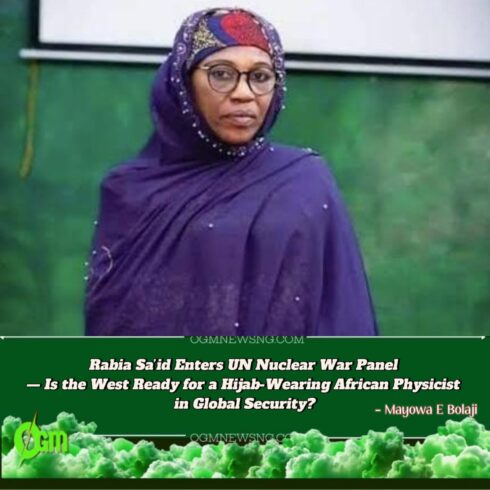
Professor Rabia Sa’id of Bayero University Kano has been appointed by the United Nations Secretary-General to join an elite, independent scientific panel tasked with evaluating the catastrophic global consequences of nuclear war. This marks the first time a Nigerian woman, let alone one from the conservative North, is handpicked to contribute to such a critical, security-sensitive taskforce.
Professor Rabia Sa’id’s emergence at the global stage has sparked not just national pride but also stirred debates within academic and diplomatic circles. Her appointment is being viewed as both a breakthrough in gender representation and a subtle challenge to Western scientific gatekeeping in global security issues.
A Muslim Woman Physicist at the Heart of Nuclear Policy
What makes Professor Rabia Sa’id’s presence even more groundbreaking is her identity: a hijab-wearing Muslim woman, navigating and now influencing one of the most guarded spaces in geopolitical science — nuclear threat assessment. Her entry redefines what global nuclear policy discourse looks like and who gets a seat at the table.
Observers across Western think tanks are split — some praising the decision as inclusive, while others question the “political correctness” of the UN’s evolving strategy. It has become clear that Rabia’s scientific brilliance is now caught in a whirlwind of global ideological scrutiny.
Northern Nigeria’s New Face of Scientific Diplomacy
Born and raised in the culturally conservative north, Professor Rabia Sa’id’s journey defies every conventional trajectory expected of women in that region. From combating gender norms to emerging as a global voice in quantum physics and environmental science, her story resonates far beyond academia.
This development may force a new conversation within Northern Nigeria’s political elite, religious institutions, and educational stakeholders. Can the region replicate this model of academic excellence while staying true to its cultural frameworks? Or will Rabia Sa’id remain an outlier rather than a prototype?
Nuclear War Panel: What It Means and Why Nigeria Should Care
The UN’s new scientific panel isn’t just a symbolic gesture — it is a core body responsible for advising global leaders on worst-case nuclear scenarios, fallout impact, planetary survival models, and peace-building strategies. The inclusion of an African voice on such a team is unprecedented and potentially game-changing.
For Nigeria, this appointment elevates its scientific diplomacy on a scale not seen since its peacekeeping contributions in the 1990s. However, critics argue that this recognition doesn’t align with Nigeria’s domestic science funding, often neglected by successive governments.
Criticism, Conspiracies, and the Global North’s Unease
Since the announcement, some right-wing commentators in Europe and North America have begun casting doubts on the qualifications and intentions behind Professor Rabia’s selection. The narrative, thinly veiled in academic terms, implies tokenism, suggesting that her presence may dilute the “rigor” of Western-dominated scientific consensus.
Meanwhile, African scholars and Pan-Africanists see this as a predictable backlash — one they describe as a deep-seated resistance to decolonizing global intellectual spaces. For them, the real controversy isn’t Professor Rabia Sa’id’s appointment, but the Global North’s discomfort with shared power.
From the Labs of Kano to the Corridors of Global Influence
Professor Rabia Sa’id’s rise is a watershed moment in both Nigerian academic history and international science diplomacy. It reflects years of silent labor in underfunded laboratories, persistent advocacy for women in STEM, and her unflinching belief in global equity in knowledge creation.
This is more than just a personal achievement. It is a clarion call to Nigerian leaders and educational institutions to prioritize scientific investment and gender inclusion. Whether Nigeria can seize this moment and institutionalize its relevance in global science remains to be seen.
Table of Contents
Discover more from OGM News NG
Subscribe to get the latest posts sent to your email.