



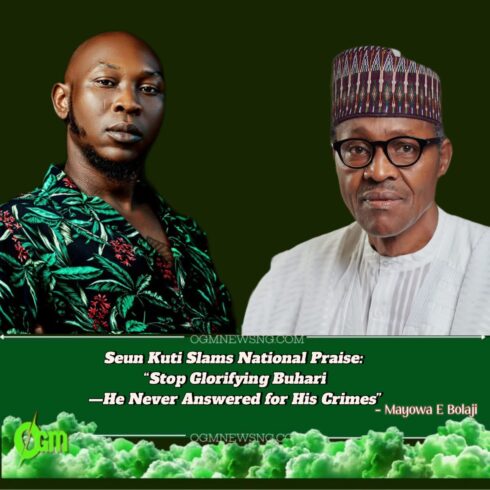
Seun Kuti, Afrobeat icon and son of the late Fela Anikulapo Kuti, has stirred public discourse with a candid and explosive reaction to the death of Nigeria’s former President Muhammadu Buhari. In an interview that has since gone viral, Seun minced no words in separating his personal grievances from the nation’s mourning rituals, stating bluntly: “Buhari dealt with my family, but I don’t see his death at old age as justice or victory.”
His statement came just days after Buhari’s state burial, amid an outpouring of tributes and reflection. But Seun’s response was far from sentimental. Instead, it resurfaced long-standing tensions between the military regime Buhari led in the 1980s and Nigeria’s cultural resistance movement—epitomized by the Kuti family.
Buhari Begins: “Order Must Be Maintained—Even if by Force”
Muhammadu Buhari, who ruled Nigeria first as a military dictator (1983–1985) and later as a democratically elected president (2015–2023), built his legacy on discipline, anti-corruption, and rigid conservatism. In his early years, he openly declared that “indiscipline” was Nigeria’s greatest enemy—and set up repressive systems to confront it, often at the expense of civil liberties.
It was under this banner of “War Against Indiscipline” that he sanctioned the brutal military raid on the Kalakuta Republic in 1984—a stronghold of Afrobeat legend Fela Kuti. Buhari’s military regime was accused of not only razing the community but also terrorizing its occupants, including Fela’s mother, Funmilayo Ransome-Kuti, who later died from injuries sustained in the attack.
Seun Kuti Responds: “There Was Never Closure for What He Did”
Reacting to news of Buhari’s passing, Seun Kuti did not shy away from revisiting the trauma inflicted on his family. “Many Nigerians may forget, but for us, the Kuti family, the scars are eternal. Justice was never served,” he said in a social media live stream that attracted global attention.
He criticized what he called the “whitewashing” of Buhari’s legacy, accusing mainstream media and state officials of glorifying a man whose rule caused widespread suffering. “Death is inevitable. But what about the justice that never came? What about the people he silenced? The artists he oppressed? The mothers he hurt?” Seun asked rhetorically.
A Nation Divided Over Buhari’s Legacy
Mohammadu Buhari may have exited the stage, but his legacy remains a battleground. While some Nigerians credit him for efforts in fighting Boko Haram and restoring national pride, others recall an era of press censorship, economic hardship, and state-sponsored brutality.
With Seun Kuti’s condemnation now echoing through media platforms and protest circles, it has become clear that not all wounds have healed. Has Nigeria truly reckoned with the past? Or has it buried uncomfortable truths alongside its leaders?
Buhari Defended: “I Did What Had to Be Done to Save Nigeria”
In interviews granted shortly before his death, Buhari was unapologetic about his leadership choices. “I did not come to be liked,” he once said. “I came to protect the country, and discipline was the price.” He often portrayed himself as a misunderstood patriot battling systemic rot and foreign manipulation.
But his stoicism is exactly what critics, like Seun Kuti, denounce. They argue that Buhari’s unwillingness to admit fault or apologize for past abuses illustrates a broader problem in Nigerian leadership—a failure to confront national trauma with truth and empathy.
The Kuti Resistance: Art, Protest, and Historical Memory
The Kuti family’s legacy of resistance, led by the legendary Fela and continued by Seun and his siblings, represents a crucial counter-narrative in Nigerian history. They’ve long used music and activism to challenge state power and reclaim African dignity, often at great personal cost.
As the debate over Buhari’s death intensifies, Seun Kuti’s statement is more than a personal grievance—it’s a call for historical accountability. “We are told to forgive, forget, and move on,” he said. “But where is the justice that makes forgiveness meaningful?”
Table of Contents
Discover more from OGM News NG
Subscribe to get the latest posts sent to your email.