

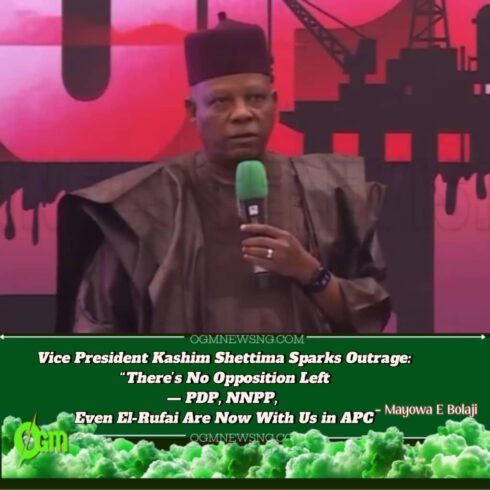
Vice President Kashim Shettima has thrown Nigeria’s political class into a whirlwind of controversy with a bold declaration that has effectively blurred the lines between opposition and ruling parties. Speaking at a recent gathering of high-ranking political figures, Shettima revealed, “We have PDP, we have new PDP, we have the coalition represented by my elder brother El-Rufai, we have NNPP-APC represented by Kwankwaso. What binds us together supersedes whatever divides us; we are all one.” This open admission has triggered shockwaves across the nation, with many questioning the authenticity of Nigeria’s democratic structure.
By suggesting that rival parties are now embedded within the ruling All Progressives Congress (APC), Shettima has ignited fears of a collapsing opposition and a rise of a one-party superstructure. Analysts argue that the comment reveals the strategic absorption of political enemies under the guise of national unity, but critics worry it may signify the death of ideological diversity and accountability in Nigerian politics.
Coalition of Convenience or National Interest? The El-Rufai Factor
Invoking the name of former Kaduna State governor Nasir El-Rufai as a symbol of this mysterious coalition, Shettima added fuel to already blazing speculation about covert political alignments. El-Rufai, long known for his fierce independence and criticism of political hypocrisy, has been quiet in recent months—leading many to suspect that backdoor negotiations and tactical partnerships have been in the works.
The reference to El-Rufai as a coalition figure is particularly alarming to opposition supporters, who believe it points to a quiet centralization of power and influence under the APC umbrella. While Shettima framed it as unity for the sake of national development, detractors say it is a classic case of political cannibalism—devouring smaller or rival groups to suppress dissent.
Kwankwaso’s Allegiance in Question: NNPP or APC Trojan Horse?
The inclusion of Rabiu Musa Kwankwaso, founder of the New Nigeria Peoples Party (NNPP), in Shettima’s speech has left many Nigerians stunned and suspicious. While Kwankwaso has long been seen as a formidable opposition leader, Shettima’s claim that he represents an “NNPP-APC” alignment has raised eyebrows about the authenticity of Kwankwaso’s anti-establishment image.
Is the former Kano State governor merely posturing as opposition while collaborating with the ruling APC? Political observers now question if the 2023 elections were simply a well-choreographed performance meant to give voters the illusion of choice, while backroom deals were already cementing a unified elite political class behind closed doors.
Democracy or Monopoly? The Collapse of Party Ideology
Shettima’s assertion that “what binds us together supersedes whatever divides us” has not only thrown party loyalty into question—it has practically nullified ideological commitments. From conservatives to progressives, from left to right, political identity appears to have been swapped for personal gain and shared elite interest.
This new model of “blended politics,” critics argue, is the final nail in the coffin for genuine opposition in Nigeria. With key players from the PDP, NNPP, and former rebel groups now seemingly aligned with the APC, voters are left wondering whether the ballot box still holds any real power—or if they’re merely ratifying choices already made in smoke-filled rooms.
Public Trust Eroded: Citizens Demand Clarity Amidst Elite Confusion
Following Shettima’s declaration, a flurry of reactions from civil society groups, political activists, and common Nigerians have flooded social media and town halls alike. Many feel betrayed and misled, arguing that such elite consolidation renders elections meaningless and threatens the very soul of Nigerian democracy.
The mood on the streets is that of unease and suspicion. “If PDP is now APC, and NNPP is also APC, then who is left to speak for the people?” lamented one activist in Kano. The lack of transparency and ideological distinction is creating a vacuum where accountability and public interest are sacrificed on the altar of elite solidarity.
APC’s Silent Strategy or National Reconciliation? The Debate Rages
Supporters of Shettima argue that his comments are a pragmatic reflection of modern governance—where unity is prioritized over rivalry for the sake of stability and development. According to this camp, national cohesion among elites might prevent political violence, foster economic growth, and reduce ethnic divisions.
However, democracy advocates see it differently: they interpret Shettima’s remarks as a red flag that the opposition has been structurally disabled. What is portrayed as reconciliation may in fact be a slow-motion political monopoly, leaving Nigerians with no meaningful choice in future elections. The line between governance and control, they warn, is thinning dangerously.
Table of Contents
Discover more from OGM News NG
Subscribe to get the latest posts sent to your email.