






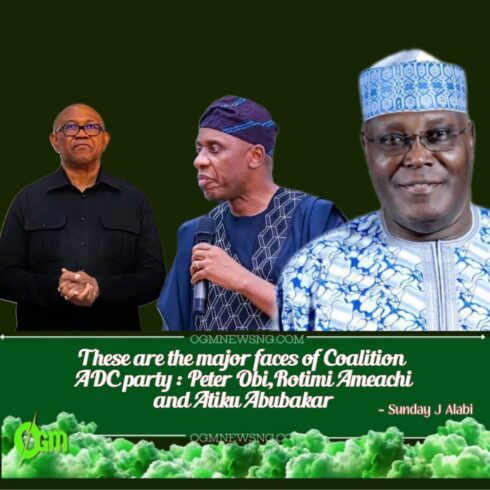
Barely 24 hours after the unveiling of the newly-formed African Democratic Congress (ADC) coalition, the focus has shifted dramatically from unity to individual ambition. The coalition, which has positioned itself as a formidable alternative to the ruling All Progressives Congress (APC), is already facing internal wrangling over who will emerge as its presidential candidate for the 2027 general election. The ADC alliance includes notable political heavyweights such as former Vice President Atiku Abubakar, former Kaduna State Governor Nasir El-Rufai, former Labour Party (LP) presidential candidate Peter Obi, former Minister of Transportation Rotimi Amaechi, and former Senate President David Mark.
What initially appeared to be a broad-based, united opposition front is now revealing cracks as early signs of competition and conflicting interests come to light. As key figures within the coalition begin to position themselves for the coveted presidential ticket, questions over zoning, strategy, and political viability are driving intense debate behind closed doors.
Amaechi Declares Interest, Advocates Southern Presidency
Former Minister of Transportation and ex-Governor of Rivers State, Rotimi Amaechi, has officially declared his ambition to contest the 2027 presidential election under the ADC platform. Speaking during an interview on Channels TV’s ‘Politics Today’ on Thursday, Amaechi confirmed his willingness to serve only one term if elected, framing his campaign around Nigeria’s deteriorating economic conditions and escalating insecurity.
Amaechi’s declaration marks the first formal entry into what promises to be a fiercely contested ADC presidential primary. He emphasised the need for the South to retain the presidency, arguing that justice demands the completion of the region’s tenure at the helm. “The South must be allowed to complete their tenure,” Amaechi insisted, making an early appeal to Nigeria’s delicate geopolitical balancing act.
His open ambition has effectively ignited the ADC’s internal contest, with various aspirants now jockeying for influence while still presenting a public façade of unity. The former minister’s positioning is likely to resonate with southern political blocs, but it also risks alienating northern stakeholders who may view the zoning debate differently.
Datti Insists: Obi Should Lead the Coalition
Yusuf Datti Baba-Ahmed, the 2023 vice-presidential candidate of the Labour Party, has publicly thrown his weight behind Peter Obi, insisting that Obi should be the ADC coalition’s presidential flagbearer. Speaking on Arise TV, Datti argued that Obi’s strong performance in the last general election, where he secured a contested 10 million votes, along with his popularity among Nigeria’s youth, makes him the coalition’s best bet.
According to Datti, Peter Obi’s appeal cuts across religious, ethnic, and generational lines, positioning him uniquely to galvanise widespread support. “Peter Obi should not be a vice-presidential candidate in 2027,” he said emphatically, noting that Obi’s political stature has grown beyond such a role.
Although Peter Obi has yet to formally resign from the Labour Party, his visible involvement in ADC coalition meetings has fuelled speculation that he may contest under its banner or withdraw if the nomination process does not favour him. His allies have also argued that the prevailing national mood for a southern presidency strengthens his case over northern contenders like Atiku.
Atiku’s Strategic Silence Fuels Speculation
Despite his silence, former Vice President Atiku Abubakar is widely believed to be carefully positioning himself for what could be his final bid for the presidency. Political insiders suggest that Atiku played a central role in brokering the ADC coalition as a means to revitalize a fragmented opposition, particularly with the People’s Democratic Party (PDP) weakened by internal strife.
Atiku’s backers argue that his experience, deep political networks, and the North’s voting power make him the most electable candidate. They believe that regardless of zoning arguments, the harsh electoral mathematics of Nigeria require a candidate who can deliver votes from the North in decisive numbers.
While many within the ADC are pushing for a southern candidate to challenge the APC, Atiku’s supporters remain undeterred, confident in his capacity to win both the party’s ticket and the national contest. The ADC primaries are shaping up to be a battle not only of personalities but of political calculations that could determine the party’s future viability.
Obi and Atiku Loyalists Mobilise as Tensions Rise
Even without formal declarations from Obi or Atiku, their respective loyalists have already begun intense mobilisation within the ADC coalition. Youth-driven movements and social media influencers associated with the ‘Obidient’ movement are actively campaigning for Obi, while northern PDP veterans and political operatives are aligning with Atiku.
There is growing speculation that the ADC may propose a joint ticket—potentially with Atiku as presidential candidate and Obi as running mate—to bridge regional divides. However, Datti Baba-Ahmed’s strong opposition to any such arrangement and the uncompromising stance of Obi’s supporters suggest that the coalition risks significant backlash if Obi is sidelined.
As the internal contest escalates, the risk of fragmentation looms large. The ADC leadership is now under pressure to manage competing ambitions and maintain cohesion, knowing that a divided opposition could hand the 2027 election to the APC by default.
ADC Faces Internal Pressures Amid APC Dismissals
While the ADC coalition has captured national attention, it is already grappling with internal pressures and skepticism about its sustainability. Former ADC presidential candidate Dumebi Kachikwu has warned of possible manipulation in favour of elite candidates, expressing concern over behind-the-scenes manoeuvring. “There’s an elite plan already taking shape. We must be vigilant,” he cautioned.
Despite these fears, other coalition figures like media personality and politician Dele Momodu have sought to allay concerns, emphasising that all members have committed to party unity and consensus-building. Momodu insisted in interviews with Vanguard and Arise TV that no individual ambition would be allowed to derail the broader goal of unseating the ruling APC.
Meanwhile, the APC and Presidency have dismissed the ADC coalition as a “hollow arrangement of displaced politicians.” Notable APC figures such as Nyesom Wike and Festus Keyamo have ridiculed the alliance, portraying it as a desperate and disorganised effort that ultimately strengthens the ruling party’s position ahead of 2027.
Outlook for 2027: Can the ADC Hold Together?
The unfolding drama within the ADC highlights both the promise and the perils of coalition politics in Nigeria. With Rotimi Amaechi’s official declaration, Datti Baba-Ahmed’s endorsement of Peter Obi, and Atiku Abubakar’s strategic silence, the coalition now faces the monumental task of balancing competing interests while projecting unity.
How the ADC navigates its internal primaries, manages zoning politics, and reconciles the ambitions of its major players will determine whether it emerges as a credible challenge to President Bola Tinubu and the APC. Failure to build consensus could see the coalition unravel before the election race formally begins.
The months ahead will test not only the political skill of the coalition’s leaders but also the patience and expectations of millions of Nigerians seeking genuine change.
Table of Contents
Discover more from OGM News NG
Subscribe to get the latest posts sent to your email.