



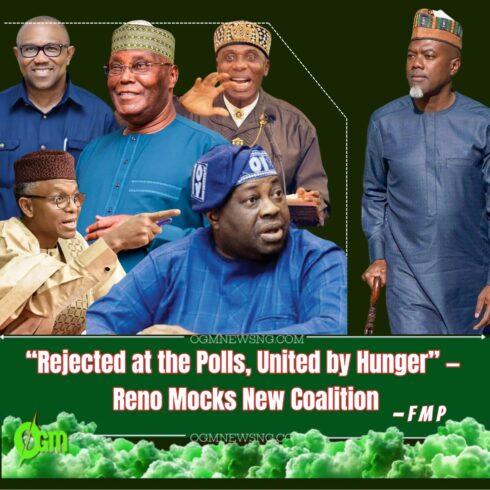
Political commentator and former presidential aide, Reno Omokri, has once again stirred the hornet’s nest with his caustic critique of Nigeria’s latest political formation—dubbed the “Coalition for National Salvation.” According to Omokri, this grand political alliance is not the future of Nigeria but a recycling of “politically displaced persons,” many of whom were rejected by Nigerians at the polls.
In a viral post, Reno Omokri described the coalition as “a room filled with leaders of yesterday and Nigeria rejects.” Citing the ADC roadshow as evidence, he pointed out the absence of any sitting governor or a formidable number of current lawmakers, asserting, “There were no incumbents there—just ex-this, former-that.”
His statement further ridiculed the coalition’s core motivation: “They say they want to rescue Nigeria, but Amaechi already confessed last month that he is hungry and looking for food. That is why they gathered—because of what to eat!” he quipped.
The Coalition Roll Call: Not Far From Reno Omokri’s Descriptions
A look at the faces behind the coalition reveals a startling truth: most of them are indeed political veterans with dwindling electoral relevance. The group includes former vice presidents, governors, ministers, and legislators—many of whom lost elections or fell out with their original political parties.
Among the prominent names are Atiku Abubakar, former Vice President and four-time presidential hopeful; Rotimi Amaechi, former Minister of Transportation and Rivers State Governor; Aminu Tambuwal, ex-governor and current senator; and Dino Melaye, known for his flamboyant political style and lost senatorial bids.
Also featured are Dele Momodu, media mogul turned PDP chieftain; Rauf Aregbesola, ex-Interior Minister and now interim ADC Secretary; and Peter Obi, 2023 Labour Party presidential candidate, who has proposed a one-term presidency if elected in 2027.
One Sitting Senator, Many Unconfirmed Ambitions
While most coalition members are political veterans, only Ireti Kingibe, Labour Party senator representing the Federal Capital Territory, is a current officeholder. Her involvement, however, remains ambiguous, as she has neither confirmed nor denied her commitment to the new alliance.
This stark contrast between former and current power holders seems to reinforce Reno Omokri’s critique. With many members nursing presidential or senatorial ambitions, the coalition appears more like a springboard for comebacks rather than a genuine people-driven movement.
Critics argue that the absence of new-generation leaders, young professionals, and grassroots representation undermines the coalition’s legitimacy and national appeal.
Reno Omokri Highlights Political Comebacks or Desperate Alignments?
Many of the coalition’s members have political baggage or electoral defeats trailing them. Babangida Aliyu, for example, failed in his Senate bid in 2015. Abubakar Malami, the former Attorney-General, left the APC amid internal wranglings and is now positioned as a legal heavyweight within the coalition.
Nasir El-Rufai, ex-Kaduna State governor, joined the coalition following internal battles within the APC, further raising questions about whether the coalition is more about settling scores than setting a new national agenda.
For many observers, this looks like a desperate attempt to remain politically relevant, especially ahead of the 2027 general elections.
Reno Omokri’s “Stomach Watch” Commentary Sparks Reactions
Reno Omokri’s humorous yet biting remark about hunger and political desperation has gained traction online. Referring to a recent public comment by Rotimi Amaechi about being “hungry,” Reno Omokri wrote: “Just negodu the stomach of someone that said he is hungry!”—a phrase that Nigerians have interpreted as a jab at opportunistic politicking.
Many social media users responded with memes and hashtags like #StomachInfrastructureReloaded and #HungryCoalition, further denting the credibility of the coalition’s public image.
However, supporters of the coalition have fired back, accusing Omokri of deflecting from PDP’s failures and lacking a constructive critique beyond social media theatrics.
Are Nigerians Buying Into the Coalition’s Agenda?
Reno Omokri is not the only Nigerian seeing the coalition as a joke, so far, public reception of the coalition has been mixed. While some believe it offers a fresh alternative to APC and PDP dominance, others say it reeks of recycled promises and familiar faces with questionable track records.
The absence of younger voices, technocrats, or community leaders has created a vacuum that critics believe discredits the movement’s “rescue Nigeria” mantra. Civil society groups have also expressed concern over the lack of policy clarity or ideological distinction within the group.
“It’s not enough to gather and say Nigeria is in trouble. We need to know how they intend to fix it and why they didn’t do it when they held power,” one Abuja-based political analyst stated.
What Next? A 2027 Third Force or a Loud Echo Chamber?
With the 2027 general elections on the horizon, this coalition could evolve into a full-fledged third force—or fade out like similar past alliances. Much will depend on how they position themselves, unite ideologically, and connect with the Nigerian youth demographic that has grown weary of old-guard politics.
Until then, critics like Reno Omokri will keep poking holes in their credibility, especially when the coalition’s faces look more like alumni of power than agents of change.
For now, the jury is still out—and Nigeria is watching.
Table of Contents
Discover more from OGM News NG
Subscribe to get the latest posts sent to your email.